

Key Takeaways
Why Recovery Belongs in Your Schedule, Not Around It
Most training plans are built around what to do on workout days. Recovery - if it appears at all - is treated as the space left over. This framing gets the relationship backwards. Muscle repair, neuromuscular adaptation, and aerobic efficiency improvements all occur during rest, not during the session that triggered them. A schedule that treats recovery as an afterthought systematically undermines the work being done in the gym or on the track.
Recovery Is Not the Absence of Training
Many people treat rest days as wasted days, but the physical adaptations from exercise - stronger muscles, improved endurance, better coordination - actually happen during recovery, not during the workout itself. Skipping adequate rest does not accelerate progress; it stalls it and raises injury risk. If you consistently feel fatigued, sore, or unmotivated, your schedule may need more recovery built in.
The complete guide to training smarter covers the full picture of recovery - from sleep and nutrition to burnout prevention - if you want a deeper foundation before building your weekly plan.
This article focuses on the practical structure: how to map a week so that training and recovery reinforce each other.
What you will need
Building Your Weekly Framework Step by Step
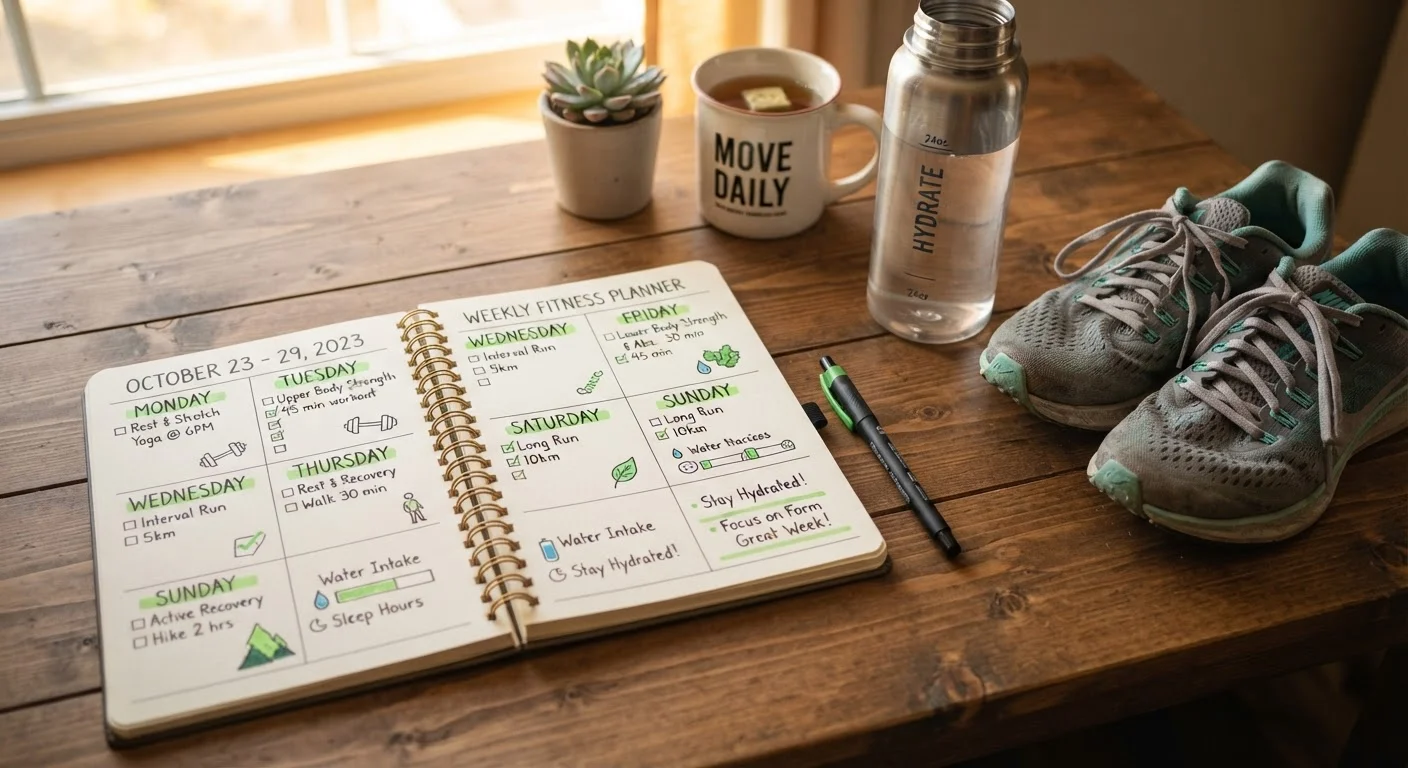
The steps below walk you through designing a balanced weekly schedule. You do not need specialized equipment or a gym membership - the same principles apply whether you run, lift weights, cycle, swim, or do bodyweight workouts at home.
Weekly planner or calendar app
Used to visually map training days, recovery days, and session intensity across the week.
Training log or journal
Tracks how you feel before and after each session to identify patterns in fatigue and progress.
Rate of Perceived Exertion (RPE) scale
A simple 1-10 scale that helps you gauge workout intensity without specialized equipment.
Count how many days you can realistically train
Start by being honest about your available time. Most people can sustain three to five training sessions per week alongside work, family, and other commitments. Choosing a number you can consistently hit beats an ambitious schedule you abandon by week two.
For beginners, three sessions per week with full rest days in between is a reliable starting point. More experienced exercisers may work with four or five sessions, but the principles below still apply.
Assign intensity levels to each training day
Not every session should push you to your limit. Label each planned training day as hard, moderate, or easy before you begin. A common pattern for a four-day week is: hard, easy, hard, moderate - with the remaining days as rest or active recovery.
The FITT principle (Frequency, Intensity, Time, and Type) gives you a useful framework for adjusting each of these variables as your fitness develops.
Place rest and active recovery days deliberately
Rest days are most effective when placed after your hardest sessions, not at random. If you do a demanding strength or cardio workout on Tuesday, Wednesday is a strong candidate for rest or gentle movement rather than another hard effort.
Active recovery - light walking, stretching, or yoga - can support blood flow and reduce muscle soreness without adding meaningful stress. See active recovery vs. complete rest to understand when each approach fits best.
Vary your training types across the week
Mixing strength training, cardiovascular work, and mobility or flexibility sessions distributes stress across different body systems, allowing partial recovery while you continue to train. For example, a lower-body strength session on Monday and an upper-body or cardio session on Wednesday means different muscle groups get recovery time even on active days.
This variety also keeps training engaging and supports more balanced overall fitness. The building blocks of an effective workout covers how warm-up, load, and recovery interact at the session level.
Review and adjust your schedule weekly
Your planned schedule is a starting point, not a fixed contract. At the end of each week, spend five minutes reviewing how your body responded. Were certain days consistently hard to complete? Did you feel recovered going into each session? Adjust the following week's plan accordingly.
Over time, this habit builds the self-awareness that separates sustainable training from cycles of effort and burnout. For a broader framework on structuring intensity over longer timeframes, see our guide on periodisation.
Use a Simple Traffic Light Check-In
Each morning, rate how you feel on a three-point scale: green (energized, ready to train), yellow (slightly tired, consider an easier session), red (fatigued, sore, or unwell - prioritize rest). This quick check-in takes less than 30 seconds and builds the habit of listening to your body before you begin any workout.
More Training Is Not Always Better
Increasing workout frequency or intensity too quickly is one of the most common causes of overuse injuries and burnout. If you are new to structured exercise or returning after a break, start conservatively and build volume gradually over several weeks. Consult a qualified fitness professional or healthcare provider before significantly increasing your training load.
For guidance on building sustainable day-to-day recovery habits that complement your schedule, see recovery habits that support long-term fitness and building a recovery routine that fits your life.
This article is for general informational purposes only and does not constitute medical or exercise prescription advice. If you have an existing health condition, injury, or are new to exercise, consult a qualified healthcare professional or certified fitness professional before beginning a new training program.