

| Typical beginner set range | 2-3 sets per exercise (American College of Sports Medicine guidelines) |
| Muscle-building rep range | 6-12 reps per set (Exercise science consensus) |
| Strength-focused rep range | 1-5 reps per set (NSCA Essentials of Strength Training) |
| Endurance rep range | 15+ reps per set (ACSM resistance training guidelines) |
| Rest for strength training | 2-5 minutes between sets (National Strength and Conditioning Association) |
| Rest for hypertrophy (muscle size) | 60-90 seconds between sets (Journal of Strength and Conditioning Research) |
Reading a Workout Plan for the First Time
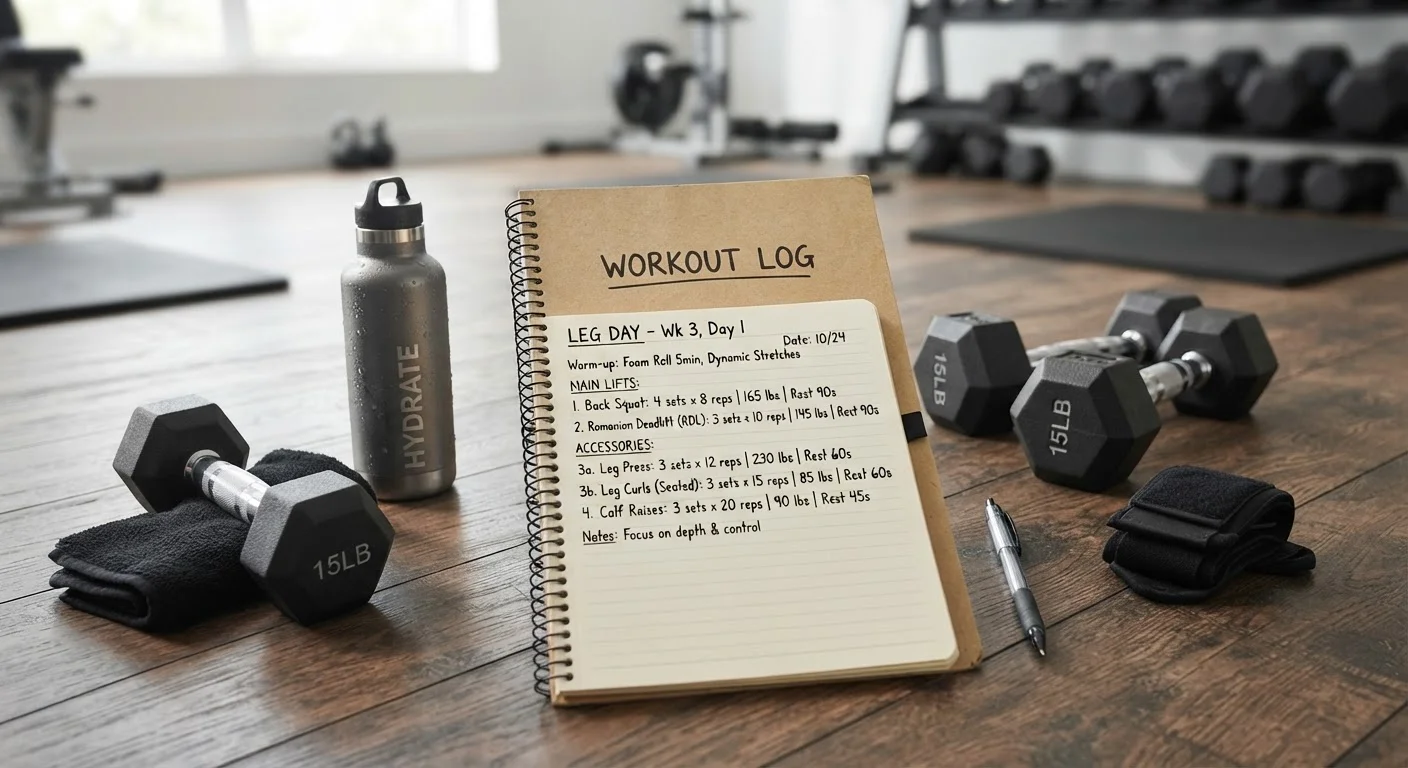
You've found a workout programme and opened it up - only to see something like "3×10 @ 60s rest" staring back at you. This shorthand is universal in fitness writing, and once you understand it, every programme becomes readable at a glance.
That notation means: 3 sets of 10 repetitions, with 60 seconds of rest between each set. Breaking it down further:
- 3 - the number of sets (groups of effort)
- 10 - the number of reps (individual movements) per set
- 60s - the rest interval before you begin the next set
These three variables - reps, sets, and rest - are the fundamental dials a workout designer turns to steer your body toward a specific outcome. See our guide to the building blocks of any effective workout for the broader picture of how all these pieces fit together.
Rep (Repetition)
One complete movement of an exercise from start to finish - for example, one push-up or one bicep curl. Reps are the smallest unit of a workout plan.
Set
A group of consecutive reps performed without stopping. Completing 10 push-ups, resting, then doing 10 more means you've done 2 sets of 10 reps.
Rest Interval
The planned pause between sets that allows muscles to partially recover. Rest length directly affects how hard the next set will feel and what training adaptation the body makes.
Volume
The total amount of work in a session, calculated by multiplying sets × reps × weight. Higher volume generally drives more muscle adaptation over time.
Tempo
The speed at which you perform each phase of a rep - usually written as a four-digit code (e.g., 3-1-2-0) representing lowering, pause, lifting, and pause durations in seconds.
Progressive Overload
Gradually increasing the challenge of an exercise - through more weight, more reps, or shorter rest - so the body continues to adapt rather than plateau.
What Rep Ranges Actually Tell You
The number of reps you perform per set isn't arbitrary - it signals the training goal the programme is built around. Here's how the ranges break down:
- 1-5 reps: Low-rep, high-load training primarily develops strength - the nervous system's ability to recruit muscle fibres powerfully. Used in powerlifting and advanced strength programmes.
- 6-12 reps: The sweet spot for hypertrophy (muscle growth). This range creates enough mechanical tension and metabolic stress to stimulate size gains.
- 13-20+ reps: Higher rep ranges train muscular endurance - the ability to sustain effort over time. These sets typically use lighter loads and shorter rest.
Beginners benefit from the full spectrum, but most general fitness programmes start in the 8-12 rep range because it builds both size and strength efficiently without requiring maximal loads.
| Typical beginner set range | 2-3 sets per exercise (American College of Sports Medicine guidelines) |
| Muscle-building rep range | 6-12 reps per set (Exercise science consensus) |
| Strength-focused rep range | 1-5 reps per set (NSCA Essentials of Strength Training) |
| Endurance rep range | 15+ reps per set (ACSM resistance training guidelines) |
| Rest for strength training | 2-5 minutes between sets (National Strength and Conditioning Association) |
| Rest for hypertrophy (muscle size) | 60-90 seconds between sets (Journal of Strength and Conditioning Research) |
Why Sets Matter - and How Many Is Enough
Think of a set as a dose of training stimulus. One set delivers some benefit; multiple sets multiply it. The American College of Sports Medicine recommends beginners start with 2-3 sets per exercise, which is enough to trigger adaptation without overwhelming recovery capacity.
More experienced exercisers often work up to 4-5 sets per exercise, or higher volumes across a full session. However, more is not automatically better - volume needs to match your recovery ability. Chasing high set counts before your body is ready is a fast route to soreness that derails consistency.
A useful rule of thumb: if you struggle to maintain form or effort on the final set, you've likely done enough - or slightly too much.
Rest Intervals: The Overlooked Variable
Rest is not laziness - it's a deliberate training tool. How long you rest between sets changes what your body adapts to, even when the reps and sets stay the same.
- Short rest (30-60 seconds): Keeps the metabolic challenge high. Muscles don't fully recover, making endurance and conditioning adaptations more likely. Common in circuit training.
- Moderate rest (60-90 seconds): The standard for hypertrophy work. Provides partial recovery so the next set can still be performed with reasonable load.
- Long rest (2-5 minutes): Used in strength and power training. Near-complete recovery allows the neuromuscular system to produce maximal effort again.
Skipping rest to save time is one of the most common beginner mistakes. Cutting your rest short means the next set is harder than the designer intended - and you may misread that difficulty as a fitness shortcoming when it's actually a pacing issue.
These Are General Guidelines, Not Prescriptions
The rep, set, and rest ranges in this article reflect general exercise science consensus for healthy adults. Individual needs vary based on fitness level, age, health status, and goals. If you have an injury, chronic condition, or are new to exercise, consult a qualified fitness professional or healthcare provider before starting a resistance training programme.
For a deeper look at how the body rebuilds between sessions, see our guide to how rest days fit into a fitness routine.
Putting It All Together: Adapting to Your Level
Most printed programmes assume a baseline fitness level. If you're newer to structured exercise, it's reasonable - and smart - to adjust the numbers downward while you build consistency.
A practical starting approach for a beginner doing a strength-focused session might look like:
- Choose a weight you can lift with good form for the full rep range.
- Complete 2 sets instead of the prescribed 3 until you feel confident.
- Honor the full rest interval - use a timer.
- Each week, aim to add one small improvement: one extra rep, slightly more weight, or one additional set.
This principle - gradually increasing the challenge - is called progressive overload, and it's the engine behind long-term progress. Training smarter with recovery in mind means understanding that the workout creates the stimulus, but rest is when the adaptation actually happens.
2-3x
Weekly training frequency for beginners to see adaptation
According to ACSM position statements on resistance training for healthy adults.
48 hrs
Minimum recovery time recommended between sessions targeting the same muscle group
Widely supported in exercise physiology literature to allow muscle protein synthesis to complete.
This article is for general informational and educational purposes only and is not a substitute for professional medical or fitness advice. Consult a qualified healthcare provider or certified fitness professional before beginning any new exercise programme, especially if you have a health condition or injury.