

Key Takeaways
Good Posture
Good posture refers to the alignment of your body's bones, muscles, and joints in a way that places minimal strain on your supporting structures during both movement and rest. It doesn't mean standing stiff or perfectly straight - it means your body is balanced and your muscles aren't working overtime to hold you upright. When your posture is healthy, your spine maintains its natural curves, your joints are in their optimal positions, and movement flows with less effort and discomfort.
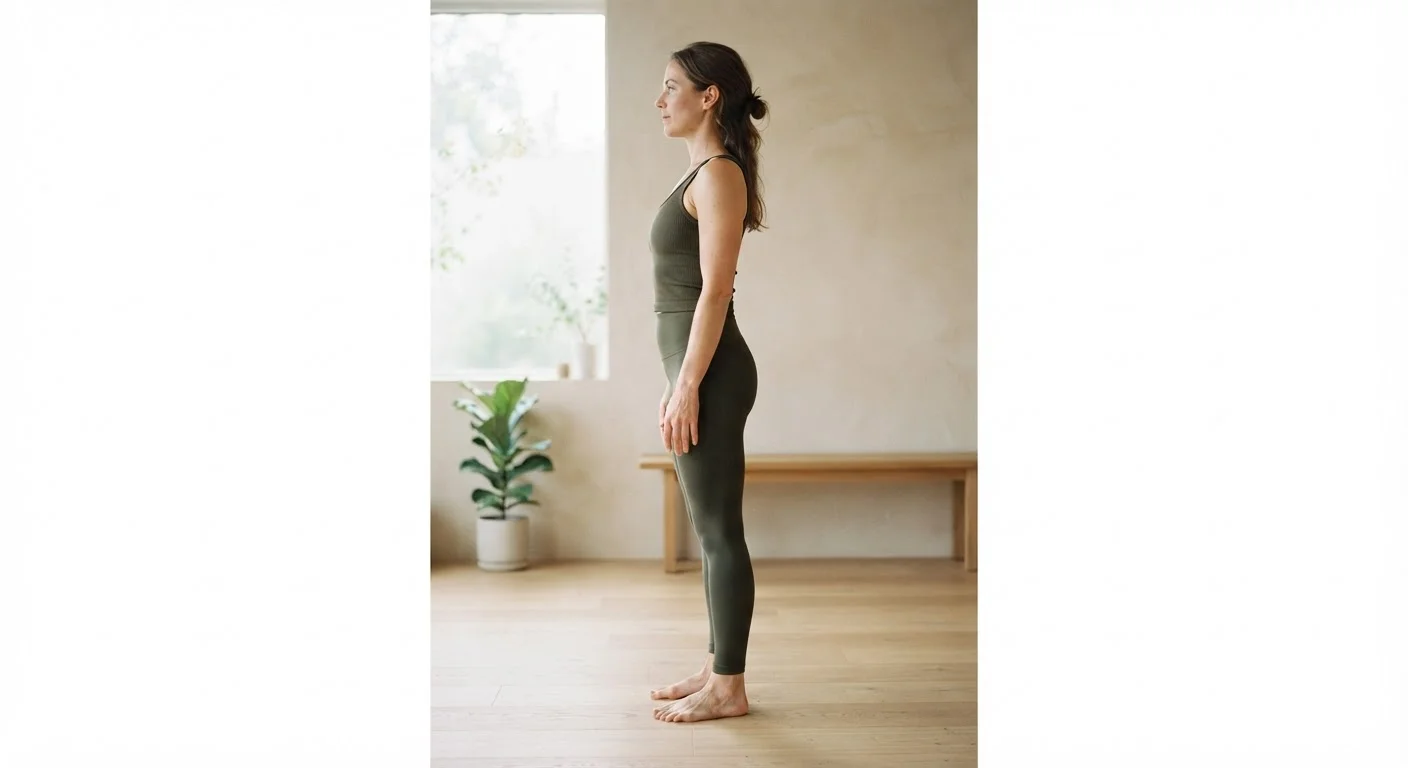
In clinical terms, ideal standing posture involves the ear, shoulder, hip, knee, and ankle aligning vertically when viewed from the side, preserving the cervical lordosis, thoracic kyphosis, and lumbar lordosis of the spine.
The Myth of the 'Perfect Straight Back'
Most people picture good posture as a rigid, military-style stance - shoulders yanked back, chest thrust forward, spine locked into a perfectly vertical line. This image is not only inaccurate, it's counterproductive. Holding your body in a forced, unnatural position actually increases muscle tension and fatigue rather than reducing it.
The human spine is naturally curved in three places: a gentle inward curve at the neck (cervical), an outward curve at the mid-back (thoracic), and an inward curve at the lower back (lumbar). These curves act as shock absorbers. Healthy posture maintains these curves - it doesn't try to flatten or exaggerate them.
Think of good posture less as a static shape you hold and more as a dynamic state of balance, where your muscles are doing only as much work as needed and your joints are under minimal unnecessary load.
One Position Is Never the Whole Answer
Even the most ergonomically correct posture becomes a problem if you hold it without moving for hours. Research consistently supports the idea that postural variety - shifting weight, changing position, taking short movement breaks - is more protective than any single 'correct' stance. Think of posture as something you cycle through, not something you lock into.
What Healthy Alignment Looks Like in Practice
In a standing position, a useful reference point is imagining a vertical line running from your ear, through your shoulder, through your hip, past your knee, and down to your ankle. Your chin should be level - not jutting forward or tucked down. Shoulders rest naturally rather than rounding forward or being forcibly pulled back. Your core muscles are gently engaged without being braced tightly.
Seated alignment follows a similar logic. Your feet should rest flat on the floor, your knees roughly level with your hips, and your lower back supported - either by a chair's lumbar support or by sitting far enough back in the seat that the chair back does the work. Screens should be at or near eye level to avoid the forward head drift that strains the neck.
The key insight is that no single position is good for extended periods. Even a well-aligned posture becomes tiring and potentially problematic if held without variation. This is why movement matters as much as positioning - something explored in depth in the article on what prolonged sitting does to your body.
80%
Adults who experience back pain at some point
The American Chiropractic Association estimates that up to 80% of people will experience back pain at some point in their lives, with poor posture and muscle imbalance among the contributing factors.
~4.5 kg
Extra neck load per inch of forward head posture
Research published in the journal Surgical Technology International found that each inch of forward head posture can add roughly 4.5 kg of effective weight load on the cervical spine.
30%
Reduction in breathing capacity linked to slouched posture
Studies in respiratory physiology have shown that slumped thoracic posture can reduce lung capacity by up to 30%, affecting both oxygen intake and energy levels.
Why Posture Matters for Long-Term Wellbeing
Poor alignment doesn't just cause back pain - though it is a significant contributor. Persistently misaligned posture places uneven load on joints, can compress nerves and blood vessels, and forces certain muscles to stay continuously contracted while others weaken from underuse. Over time, this can contribute to tension headaches, reduced breathing capacity, hip tightness, and even balance issues.
For older adults, posture becomes especially relevant to maintaining independence and reducing fall risk. The active aging hub covers how physical resilience - including alignment habits - supports mobility and strength as the body changes with age.
The good news is that posture is largely trainable. Strengthening the muscles that support the spine - particularly the core, glutes, and upper back - makes good alignment easier to maintain naturally, rather than requiring constant conscious effort. Building small, consistent movement habits is one of the most effective long-term strategies, as discussed in the guide on movement habits that compound over time.
A Simple Posture Reset You Can Do Anytime
Try this quick reset: stand or sit tall, roll your shoulders gently back and down, let your chin float level, and take a slow breath in. This brief reset doesn't require equipment and can be done at a desk, in a car, or during any pause in your day. Over time, small consistent resets like this help retrain your baseline alignment - and pair well with the principles of good movement form in any exercise you do.
This article is for general informational purposes only and is not a substitute for professional medical advice. If you experience persistent pain, speak with a qualified healthcare professional.