

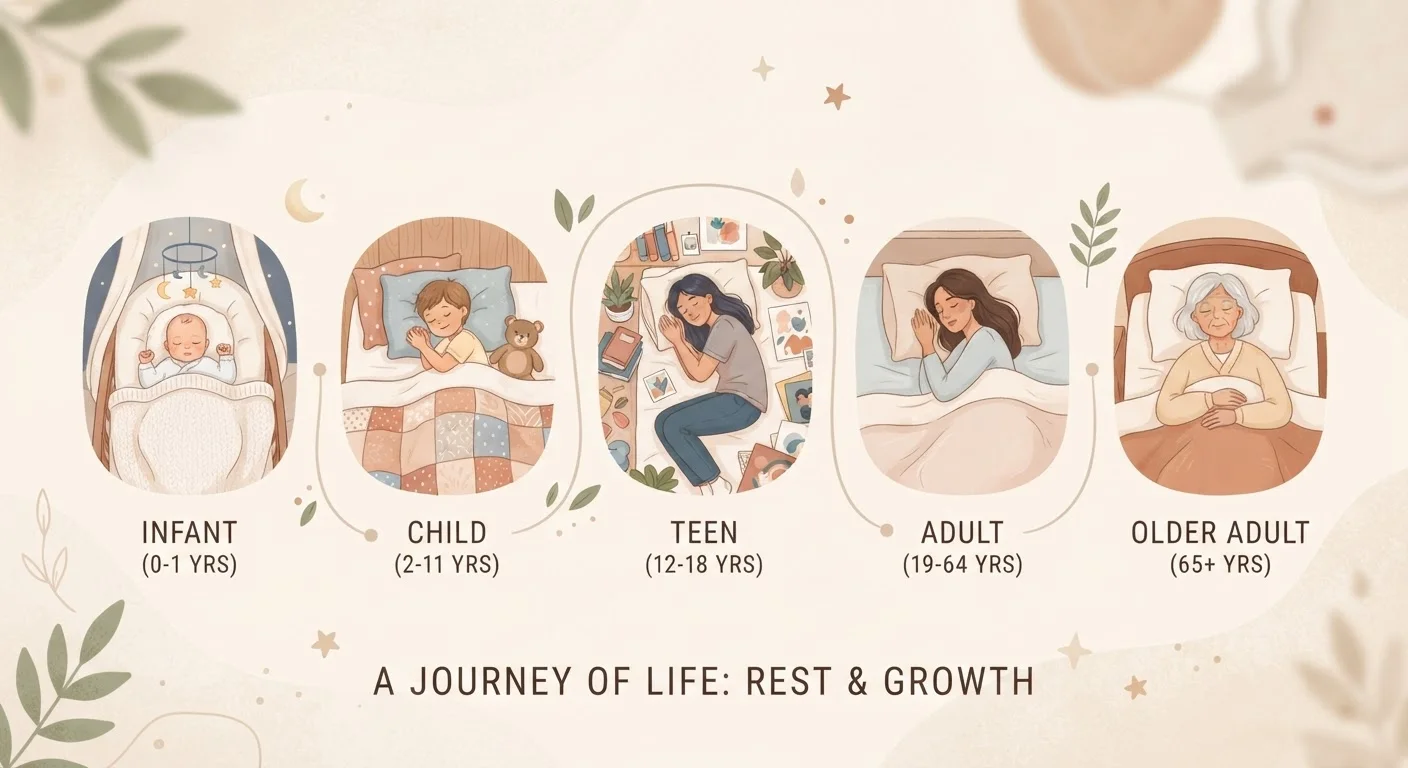
Why Sleep Needs Change as We Age
Sleep is not a fixed biological constant - it is a dynamic process that shifts in duration, depth, and structure across every stage of life. The brain and body have different repair and development priorities depending on age, and those priorities are reflected in how much sleep we need and what that sleep looks like at a cellular level.
For a deeper foundation in sleep science, see our complete guide to sleep and recovery, which covers the mechanisms behind restorative rest. This reference article focuses specifically on how recommendations and sleep architecture evolve through life's stages.
This article is for general informational and educational purposes only and does not constitute medical advice. If you have concerns about your sleep or health, please consult a qualified healthcare professional.
Sleep by Life Stage: What the Research Says
The American Academy of Sleep Medicine - whose recommendations are widely cited in clinical practice - provides consensus guidelines on sleep duration by age group. Here is how those break down:
Infants and Toddlers (0-2 years)
Newborns typically need 14-17 hours of sleep per 24-hour period, including naps. Sleep at this stage is heavily weighted toward REM (rapid eye movement) sleep, which supports rapid brain development. By age one, total sleep needs generally settle to 12-16 hours, with nighttime consolidation gradually increasing.
Children (3-12 years)
Preschool-age children need approximately 10-13 hours, while school-age children thrive on 9-12 hours. Slow-wave (deep) sleep is especially prominent in childhood, supporting physical growth and memory consolidation. Regular sleep-wake patterns at this stage have been associated with better attention and behavioral regulation.
Teenagers (13-18 years)
Adolescence brings a well-documented biological shift in circadian timing - teens naturally tend toward later sleep and wake times, a phenomenon sometimes called sleep phase delay. Despite this, many teens require 8-10 hours for optimal function. Chronic sleep restriction during this period is associated with mood difficulties and impaired academic performance.
Adults (18-64 years)
Most adults need 7-9 hours per night. Sleep architecture during adulthood stabilizes but begins a gradual shift: slow-wave sleep decreases incrementally with each decade, and nighttime awakenings become somewhat more common. Good sleep hygiene fundamentals become especially important for maintaining quality during these years.
Older Adults (65 and older)
Adults 65 and older still require 7-8 hours, though sleep structure changes considerably. Deep slow-wave sleep diminishes further, REM periods may shorten, and the sleep-wake cycle often shifts earlier - sometimes called sleep phase advance. More frequent nocturnal awakenings are common, though persistent insomnia is not an inevitable part of aging and deserves medical attention. For related lifestyle context, see our hub on aging well daily.
REM sleep
Rapid Eye Movement sleep is a stage characterized by vivid dreaming and high brain activity. It plays a key role in memory processing and emotional regulation, and is especially abundant in infancy.
Slow-wave sleep
Also called deep sleep or N3, this is the most physically restorative sleep stage. It supports tissue repair, immune function, and memory consolidation, and declines naturally with age.
Circadian rhythm
The body's internal 24-hour clock that regulates sleep-wake timing, hormone release, and other biological cycles. It shifts at different life stages, most notably during adolescence and older adulthood.
Sleep phase delay
A natural biological shift common in adolescence where the internal clock pushes the preferred sleep and wake time later, making early school schedules biologically challenging for many teens.
Sleep efficiency
The proportion of time spent in bed that is actually spent asleep. A higher percentage generally indicates more consolidated, restorative sleep.
Sleep architecture
The overall structure and pattern of sleep stages - including light sleep, deep sleep, and REM - across a full night. Architecture changes predictably as we age.
Common Sleep Quality Markers Across the Lifespan
Duration is only part of the picture. Sleep quality - how restorative sleep actually feels and functions - is equally important, and certain markers shift predictably with age.
25%
Portion of infant sleep spent in REM
Newborns may spend up to 50% of sleep time in REM, reflecting intense early brain development; the proportion decreases steadily through childhood.
7-9 hrs
Recommended nightly sleep for most adults
The American Academy of Sleep Medicine identifies this range as optimal for adult health, cognitive performance, and well-being.
~70%
Average sleep efficiency in healthy older adults
Research suggests sleep efficiency can decrease from roughly 95% in young adults to around 70-80% in older adults, even with adequate time in bed.
- Sleep efficiency (the percentage of time in bed actually spent asleep) tends to be high in childhood and decreases modestly with age.
- Sleep latency (how long it takes to fall asleep) varies widely across life stages and is influenced by circadian factors, stress, and health conditions.
- Slow-wave sleep peaks in early childhood and declines progressively - by late adulthood it may represent only a small fraction of total sleep time.
- REM sleep is highest in infancy and stabilizes through adulthood before declining slightly in older age.
Understanding how your current life stage shapes sleep can help you set realistic expectations and identify patterns worth discussing with a healthcare provider. This is especially relevant if you are also thinking about how physical activity intersects with rest - our reference on daily movement across the lifespan covers that parallel journey. You can also explore detailed duration benchmarks in our article sleep needs across the lifespan.
When to Talk to a Healthcare Provider
Changes in sleep across life stages are normal, but some symptoms - such as persistent insomnia, excessive daytime sleepiness, or loud snoring - may signal an underlying sleep disorder at any age. These concerns are not simply a result of getting older and are worth raising with a qualified healthcare professional. Do not adjust medications or supplements for sleep without medical guidance.