

Key Takeaways
Our Verdict
The science consistently supports prioritizing unsaturated fats - particularly monounsaturated and omega-3 polyunsaturated fats - over saturated fats for cardiovascular and overall health. Saturated fat isn't a poison, but evidence suggests limiting it and replacing it with healthier fat sources rather than refined carbs. Dietary context always matters: what you eat alongside fat shapes how your body responds.
| Best for | Recommended |
|---|---|
| Those focused on heart health and cholesterol management | Unsaturated fats (olive oil, nuts, fatty fish) |
| Those following whole-food eating patterns with moderate dairy and meat | Limited saturated fat within a balanced diet |
| Those looking to reduce overall diet-related disease risk | Unsaturated fats as the primary fat source |
Why Fat Got Such a Bad Reputation
For decades, dietary fat was cast as the villain behind heart disease and weight gain. Public health campaigns in the 1980s and 1990s pushed low-fat eating, and "fat-free" became shorthand for healthy. The science, however, was always more nuanced - and decades of subsequent research have substantially reshaped how nutrition experts understand fat's role in the diet.
The core issue is that "fat" is not a single thing. It encompasses several chemically distinct types - saturated, monounsaturated, polyunsaturated, and trans fats - each of which behaves differently in the body. Lumping them together under one label led to widespread confusion that still persists. As explored in common diet myths, the idea that fat categorically causes harm is one of the most enduring misconceptions in nutrition.
Focus on Fat Quality, Not Just Quantity
Rather than aiming to eat as little fat as possible, nutrition science now emphasizes choosing higher-quality fat sources. Swapping butter for olive oil or reaching for a handful of walnuts instead of a processed snack are practical shifts aligned with the evidence. Small, consistent changes to fat sources can compound meaningfully over time without requiring a dramatic dietary overhaul.
Unsaturated Fats: What the Evidence Supports
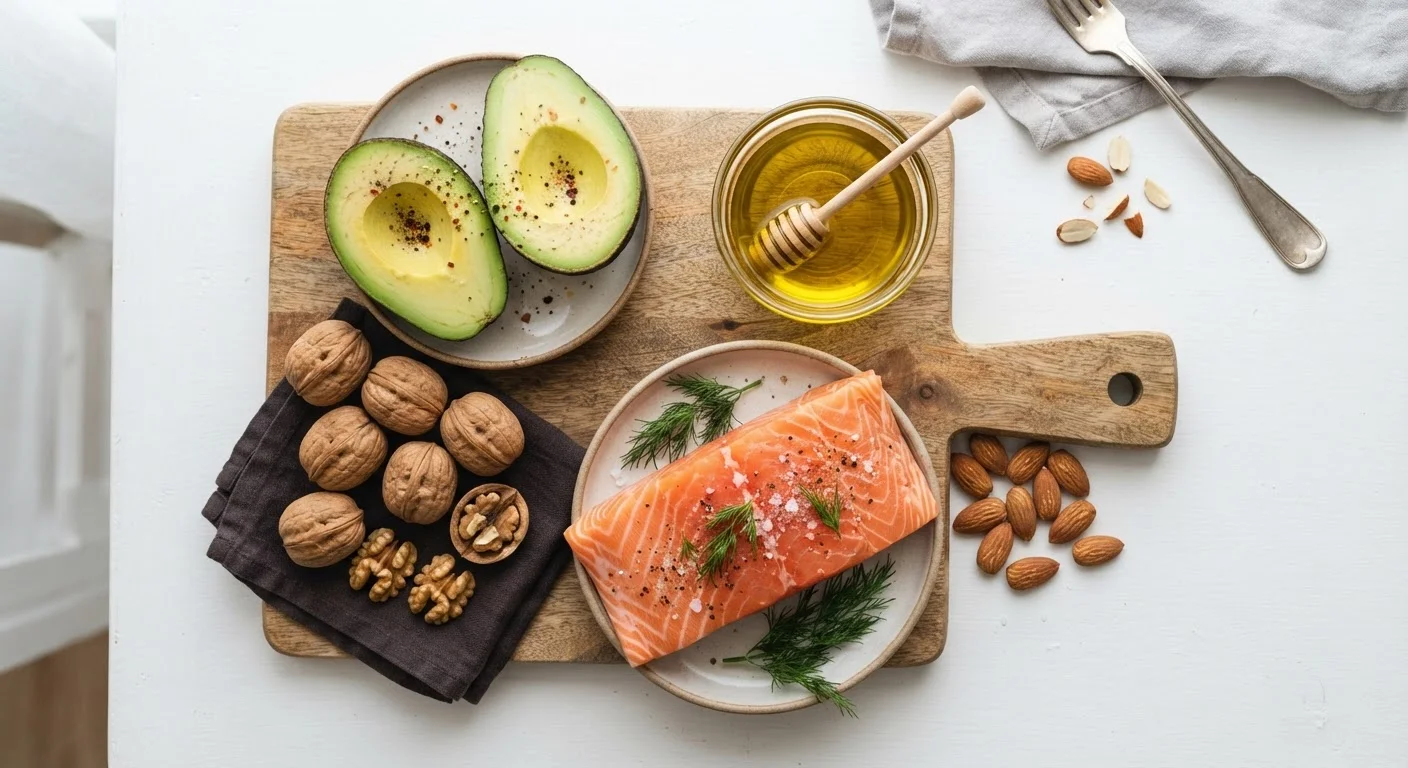
Unsaturated fats are liquid at room temperature and are found primarily in plant-based oils, avocados, nuts, seeds, and fatty fish. They divide further into two main categories:
- Monounsaturated fats (MUFAs): Abundant in olive oil, avocado, and almonds. Research - including landmark trials on the Mediterranean diet - consistently links these fats to improved LDL cholesterol profiles and reduced cardiovascular risk.
- Polyunsaturated fats (PUFAs): Include omega-3 and omega-6 fatty acids. Omega-3s, found in fatty fish like salmon and sardines, flaxseeds, and walnuts, are associated with reduced inflammation and lower triglyceride levels. Omega-6s, while essential, are already abundant in the typical American diet.
The American Heart Association and the Dietary Guidelines for Americans both recommend replacing saturated fats with unsaturated fats as a practical strategy for cardiovascular health. The Mediterranean and DASH diets - two of the most evidence-backed eating patterns - both emphasize unsaturated fat sources prominently.
<10%
Recommended saturated fat limit (daily calories)
The 2020-2025 Dietary Guidelines for Americans advise limiting saturated fat to less than 10% of total daily caloric intake.
~30%
Reduced cardiovascular risk with fat substitution
Research published in leading nutrition journals suggests replacing saturated fat with polyunsaturated fat is associated with meaningful reductions in coronary heart disease risk.
Saturated Fats: Where the Science Stands
Saturated fats are solid at room temperature and come primarily from animal-based foods - beef, pork, butter, cheese, and full-fat dairy - as well as tropical oils such as coconut and palm oil. Their relationship with health has been debated, but the mainstream scientific consensus remains cautionary.
Well-established research shows that saturated fat raises LDL (low-density lipoprotein) cholesterol, a recognized risk factor for atherosclerosis and cardiovascular disease. The 2020-2025 Dietary Guidelines for Americans recommend keeping saturated fat intake below 10% of total daily calories.
Some studies in recent years have questioned whether saturated fat is directly harmful or whether the replacement nutrient matters more. Evidence suggests that swapping saturated fat for refined carbohydrates and added sugars offers little cardiovascular benefit - but replacing it with unsaturated fats does. This nuance is important: it's not just about cutting saturated fat, but about what fills that gap. The food context matters enormously, a theme developed further in understanding whole foods vs. ultra-processed foods.
| Unsaturated Fats | Saturated Fats | |
|---|---|---|
| Primary sources | Olive oil, nuts, avocado, fatty fish | Butter, red meat, full-fat dairy, coconut oil |
| State at room temperature | Liquid | Solid |
| Effect on LDL cholesterol | Generally lowers or neutral | Raises LDL cholesterol |
| Cardiovascular research | Consistently favorable associations | Cautionary; limit recommended |
| Dietary guideline stance | Prioritize as main fat source | Keep below 10% of daily calories |
| Role in evidence-based diets | Central in Mediterranean, DASH, and others | Limited; not eliminated in most patterns |
Trans Fats: The Outlier Everyone Agrees On
Artificial trans fats - created by partially hydrogenating vegetable oils - are the one type of dietary fat where scientific consensus is unequivocal: they are harmful and should be avoided. They raise LDL cholesterol while simultaneously lowering HDL ("good") cholesterol, creating a particularly unfavorable cardiovascular risk profile.
The US Food and Drug Administration determined that partially hydrogenated oils - the primary source of artificial trans fats - are no longer generally recognized as safe, and their use in the food supply has been largely eliminated. Small amounts of naturally occurring trans fats exist in some animal products and are not considered equivalently harmful.
Putting It Together: A Practical Framework
For most people, the practical guidance that emerges from the evidence is straightforward:
- Use olive oil, avocado oil, or other unsaturated fat sources as your primary cooking and dressing fats.
- Include fatty fish, nuts, and seeds regularly as part of an overall balanced diet.
- Limit - but don't necessarily eliminate - saturated fat, particularly from processed meats and high-fat dairy consumed in large quantities.
- Avoid partially hydrogenated oils where still present in packaged foods by checking ingredient labels.
- Focus on overall diet quality rather than obsessing over a single nutrient.
As the core principles shared by evidence-based diets make clear, no one food or nutrient determines health outcomes in isolation. The pattern of eating across time is what matters most.
This article is for general informational and educational purposes only and does not constitute medical or nutritional advice. Consult a qualified healthcare professional or registered dietitian for guidance tailored to your individual health needs.