

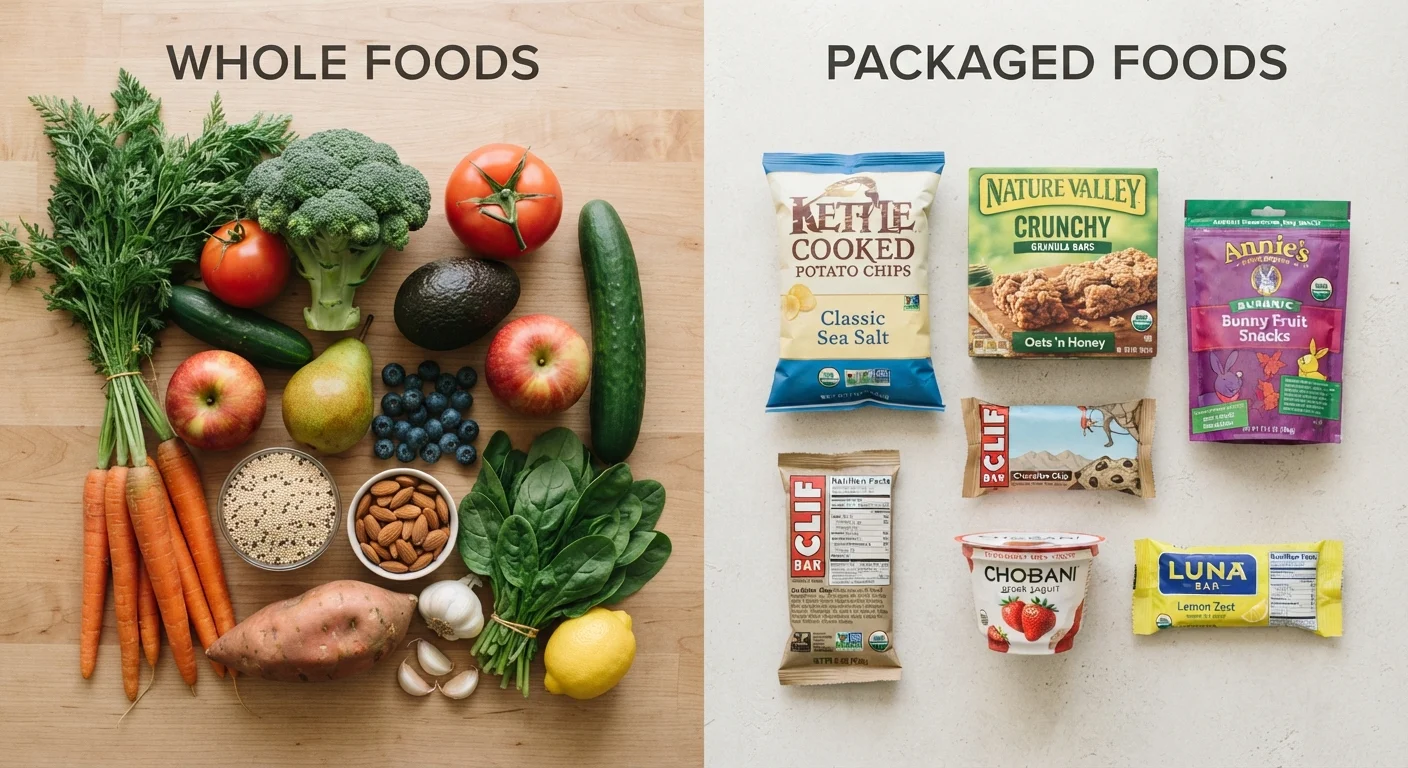
Key Takeaways
Option A
Whole Foods
The minimally altered, nutrient-dense foundation of most dietary guidelines.
Best for: People seeking nutrient density, dietary fiber, and ingredients close to their natural state.
Option B
Ultra-Processed Foods
Industrially formulated products designed for convenience, palatability, and shelf stability.
Best for: Understanding what to minimize - and recognizing that not all processed foods fall into this category.
If you want to maximize nutrient density in your daily diet
Whole Foods
Whole foods deliver fiber, vitamins, minerals, and beneficial plant compounds with minimal interference from industrial processing.
If you're trying to identify which packaged foods to limit
Ultra-Processed Foods
Learning to recognize ultra-processed products helps you make more deliberate choices without needing to avoid all packaged food.
If you're balancing convenience with healthful eating
Whole Foods
Minimally processed options like canned beans, plain oats, and frozen vegetables offer convenience without sacrificing nutritional integrity.
If you're researching the science behind dietary patterns
Whole Foods
Evidence from large cohort studies consistently supports dietary patterns rich in whole foods for long-term wellbeing.
How Nutrition Researchers Classify Food Processing
Not all processing is created equal. Boiling an egg is processing. So is manufacturing a packaged snack cake engineered with emulsifiers, artificial flavors, and modified starches. Nutrition researchers needed a framework to capture that difference, which is why the NOVA classification system - developed by researchers at the University of São Paulo - has gained wide currency in public health nutrition.
NOVA organizes foods into four groups: Group 1 covers unprocessed or minimally processed foods (fresh fruit, plain meat, eggs, dried legumes); Group 2 covers processed culinary ingredients (oils, flour, sugar used in cooking); Group 3 covers processed foods (canned fish, cheese, cured meats); and Group 4 covers ultra-processed foods - industrially formulated products that go far beyond cooking and preservation.
Understanding this spectrum matters because it shifts the conversation from single nutrients to the overall nature of what we eat. For a deeper look at how food quality extends beyond calorie counts, the distinction between processing levels is a useful starting point.
| Criterion | Whole Foods | Ultra-Processed Foods |
|---|---|---|
| Definition | Unaltered or minimally altered from natural state | Industrially formulated with additives and refined ingredients |
| NOVA Group | Group 1 (and some Group 3) | Group 4 |
| Fiber Content | Naturally high in fiber | Often low or removed during processing |
| Micronutrient Density | Rich in vitamins, minerals, phytonutrients | Often low; may be partially fortified |
| Ingredient List | Short; recognizable whole-food ingredients | Long; includes additives, flavors, stabilizers |
| Satiety Effect | Generally promotes fullness due to fiber and water | Often engineered to minimize satiety signals |
| Associated Health Research | Linked to favorable long-term health outcomes | Associated with higher risk of chronic disease at population level |
| Examples | Oats, lentils, apples, eggs, plain yogurt | Packaged snack cakes, flavored chips, sugary beverages |
What Makes a Food 'Whole' or 'Ultra-Processed'?
A whole food is one that remains close to its natural form - an apple, a handful of walnuts, a piece of salmon, a bowl of oats. These foods retain their original matrix: fiber, water, vitamins, minerals, and phytonutrients (natural plant compounds) that interact in ways nutritional science is still working to fully understand.
An ultra-processed food, by contrast, is not simply a food that comes in a package. It is a formulation - assembled from refined ingredients and additives such as high-fructose corn syrup, hydrogenated oils, artificial flavors, colorings, emulsifiers, and preservatives. The goal of ultra-processing is often palatability, shelf life, and convenience rather than nutritional completeness.
Common ultra-processed examples include packaged sweet snacks, flavored chips, ready-to-heat frozen meals with long ingredient lists, sugar-sweetened beverages, and certain reconstituted meat products. Importantly, a can of plain tomatoes or a bag of frozen edamame is not ultra-processed - it is a minimally processed whole food in a convenient format.
Not All Packaged Food Is Ultra-Processed
A common misconception is that any food sold in a package is ultra-processed. Canned beans, plain frozen vegetables, bagged whole grains, and unsweetened nut butters are minimally processed foods that retain strong nutritional profiles. The key question is whether the product has been fundamentally reformulated with additives and refined substrates - not simply whether it has been preserved or packaged for convenience.
For a practical guide to reading food labels without confusion, understanding ingredient lists is a useful tool for placing packaged products on the processing spectrum.
What the Research Shows About Health Outcomes
A substantial and growing body of epidemiological research has examined associations between ultra-processed food consumption and health outcomes. Large prospective studies - including those published in The BMJ and JAMA Internal Medicine - have found that higher ultra-processed food intake is associated with elevated risks of cardiovascular disease, type 2 diabetes, obesity, and all-cause mortality. These are associations observed at the population level and do not prove direct causation for any individual.
Researchers hypothesize several mechanisms: ultra-processed foods tend to be calorie-dense but low in fiber and micronutrients; they are often engineered to promote overconsumption; and their additives may adversely affect gut microbiome composition. A landmark randomized controlled trial published in Cell Metabolism (Hall et al., 2019) found that participants assigned an ultra-processed diet consumed significantly more calories and gained more weight over two weeks compared with those on an unprocessed diet, even when both diets were matched for total calories, sugar, fat, and fiber on paper.
57%
of average US adult caloric intake from ultra-processed foods
A study published in BMJ Open (Martínez Steele et al., 2017) estimated that ultra-processed foods contributed approximately 57% of daily energy intake in a US adult sample.
~500 kcal/day
Extra calories consumed on ultra-processed diet
In the Hall et al. (2019) randomized controlled trial in Cell Metabolism, participants on an ultra-processed diet consumed roughly 500 more calories per day than those on an unprocessed diet.
12%
Higher all-cause mortality risk per 10% increase in ultra-processed intake
A large prospective cohort study published in JAMA Internal Medicine (Rico-Campà et al. and related analyses) found each 10-percentage-point increase in ultra-processed food consumption was associated with a 12% higher risk of all-cause mortality.
These findings reinforce why understanding how whole and ultra-processed foods differ in the body is relevant beyond label reading.
Practical Implications: Building a More Whole-Food Diet
Shifting toward whole foods does not require an all-or-nothing overhaul. Dietary patterns - not individual foods - are what the evidence most consistently supports. As explored in our overview of popular eating patterns and their research base, the Mediterranean and DASH diets are among the best-studied examples of whole-food-centered approaches.
Practical steps include prioritizing fresh, frozen, or plain-canned vegetables and legumes; choosing whole grains over refined grain products; selecting plain dairy or minimally processed proteins; and cooking at home more frequently using Group 2 ingredients (oils, herbs, spices). When purchasing packaged foods, shorter ingredient lists featuring recognizable whole-food components are a reasonable proxy for lower processing levels.
It also helps to consider overall eating patterns rather than fixating on single superfoods - the sum of daily food choices matters more than any one meal or ingredient.
This article is for general informational and educational purposes only and is not a substitute for professional medical or dietary advice. Consult a registered dietitian or qualified healthcare provider for guidance tailored to your individual health needs.