

Key Takeaways
Why your environment shapes how much you move
Most people approach inactivity as a willpower problem. In reality, a growing body of behavioral science research suggests that the design of our immediate surroundings is a more powerful determinant of daily movement than motivation or intention alone. If sitting down requires less effort than standing up, most people will sit. If exercise equipment is hidden away, most people will not use it.
This is not a character flaw - it is how human decision-making works. We consistently choose the option that demands the least effort, a tendency behavioral researchers call the path of least resistance. The practical implication is that you can do less mental work around fitness by engineering your environment so that movement is simply the easier choice.
This complements - rather than replaces - structured workouts. For a broader look at how incidental movement builds real health benefits, see our guide on moving more without a gym. And if you are new to building activity into your life, starting an active lifestyle after years of being sedentary offers a low-pressure starting point.
What you will need
Yoga mat or exercise mat
Creates a designated, ready-to-use movement zone that makes starting a session effortless.
Resistance bands
Lightweight and storable, these serve as a visible reminder to incorporate strength movements into short breaks.
Standing desk converter or adjustable riser
Allows alternating between sitting and standing during desk-based work, reducing prolonged sedentary time.
Timer or phone alarm
Serves as a scheduled environmental cue to prompt movement breaks throughout the day.
Wall-mounted hooks or storage rail
Keeps exercise equipment visible and accessible rather than buried in a closet.
Step-by-step: reshaping your home for daily movement
The following steps are designed to be implemented gradually - you do not need to overhaul everything at once. Even one or two changes can meaningfully shift the amount of movement woven into your day.
Audit your home for movement friction
Walk through each room and note what makes activity easy or difficult. Ask yourself: Is my exercise mat rolled up in a cupboard? Are my walking shoes near the door? Is the sofa the only comfortable place to sit? Friction - the number of steps between you and movement - is the single biggest predictor of whether you will act. Write down two or three friction points in the spaces where you spend the most time.
Create a visible, always-ready movement zone
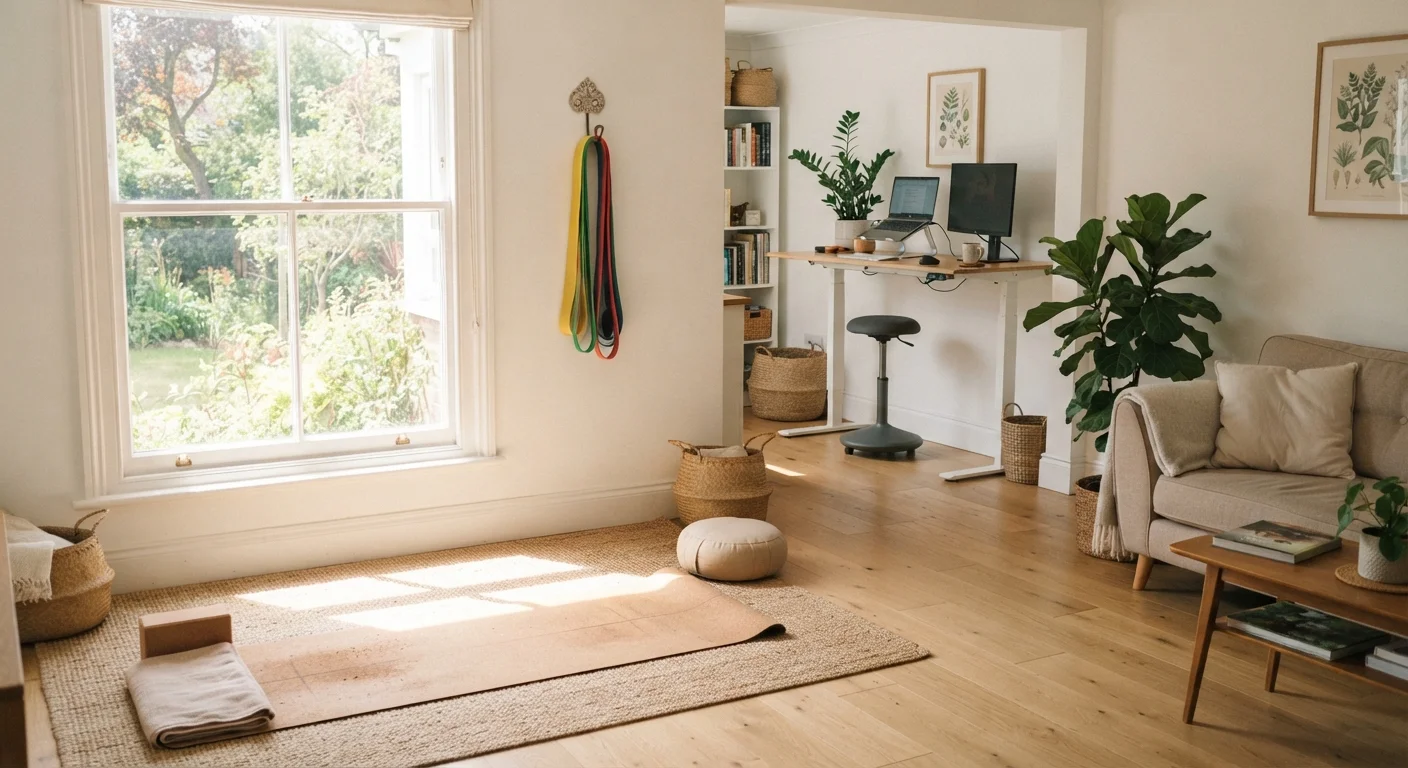
Identify a clear patch of floor - even 6 by 4 feet is enough - and keep a mat permanently unrolled there. Research on behavioral design consistently shows that when the action requires zero setup, people are significantly more likely to do it. Keep a short list of five-minute routines (stretches, bodyweight squats, balance work) pinned or written nearby so you never have to decide what to do.
Store equipment visibly, not conveniently out of sight
Hang resistance bands on a hook by the door. Place a light kettlebell beside your desk rather than inside a cabinet. Keep walking shoes by the front entrance, not in a wardrobe. Visibility functions as a passive prompt - the equipment itself becomes a reminder. This principle, sometimes called environmental cueing, works because you are relying on your surroundings rather than memory or motivation to trigger behavior.
Redesign your sitting habits with active alternatives
Prolonged uninterrupted sitting is associated with increased cardiometabolic risk independent of overall exercise levels, according to research published in exercise science literature. Introduce at least one standing or active option in your main work or relaxation area. A standing desk converter, a balance board, or even replacing one chair with a low stool that encourages upright posture can meaningfully interrupt sedentary time. Aim to shift positions every 30-60 minutes rather than standing all day, which introduces its own discomfort.
Make active routes the default path through your home
Small architectural nudges work. Place your printer, water bottle station, or phone charger at the far end of the room rather than within arm's reach. Take the longer route between rooms habitually. Put items you frequently need - snacks, books, remote controls - in locations that require you to stand up and walk. These micro-decisions accumulate into thousands of extra steps each week without any formal exercise session. This is the foundation of what exercise scientists call NEAT - the energy expended in all movement outside structured workouts.
Anchor movement to existing daily habits
Choose two or three activities you already do every day - brewing coffee, brushing teeth, waiting for a video call to start - and pair each one with a brief physical action. Ten calf raises while the kettle boils. A wall stretch while brushing your teeth. A short walk around the block between back-to-back calls. This technique, known as habit stacking, embeds movement into your routine without requiring extra time or willpower. Over weeks, the pairing becomes automatic.
Start with the room you use most
You do not need to redesign your entire home. Focusing your first changes on the one room where you spend the majority of your waking hours will deliver the greatest return. Once new habits take root there, extending the approach to other spaces feels far more manageable.
Remember that your home is just one part of the picture. Social and environmental barriers to daily activity - including neighborhood design and workplace culture - also shape how much people move, often in ways outside individual control.
Environmental design has real limits
Home modifications are a supportive strategy, not a cure-all. They work best alongside realistic expectations and, where appropriate, professional guidance. If pain, fatigue, or a chronic health condition is limiting your movement, speak with a healthcare provider before attempting any new physical activity routine.
Keeping the momentum going
An active home environment works best as a system of layered cues rather than a single intervention. Revisit your friction audit every few months - what worked initially may stop registering as your brain habituates to familiar cues. Rotate equipment placement, introduce a new habit stack, or shift your movement zone to a different room to keep the environment feeling fresh.
For additional ideas on building activity into the fabric of ordinary life, explore turning everyday tasks into opportunities to move more. And when motivation inevitably dips - as it does for everyone - the strategies in sustaining an active lifestyle when motivation fades can help you rely on your environment rather than enthusiasm to keep moving.
These principles apply across ages and ability levels. Whether you are managing a busy household or focusing on staying mobile as you get older, the core idea is the same: reduce the gap between where you are and where movement happens.
This article is for general informational purposes only and is not a substitute for professional medical or fitness advice. If you have a health condition or have been inactive for an extended period, consult a qualified healthcare professional before making significant changes to your activity level.