

Key Takeaways
Option A
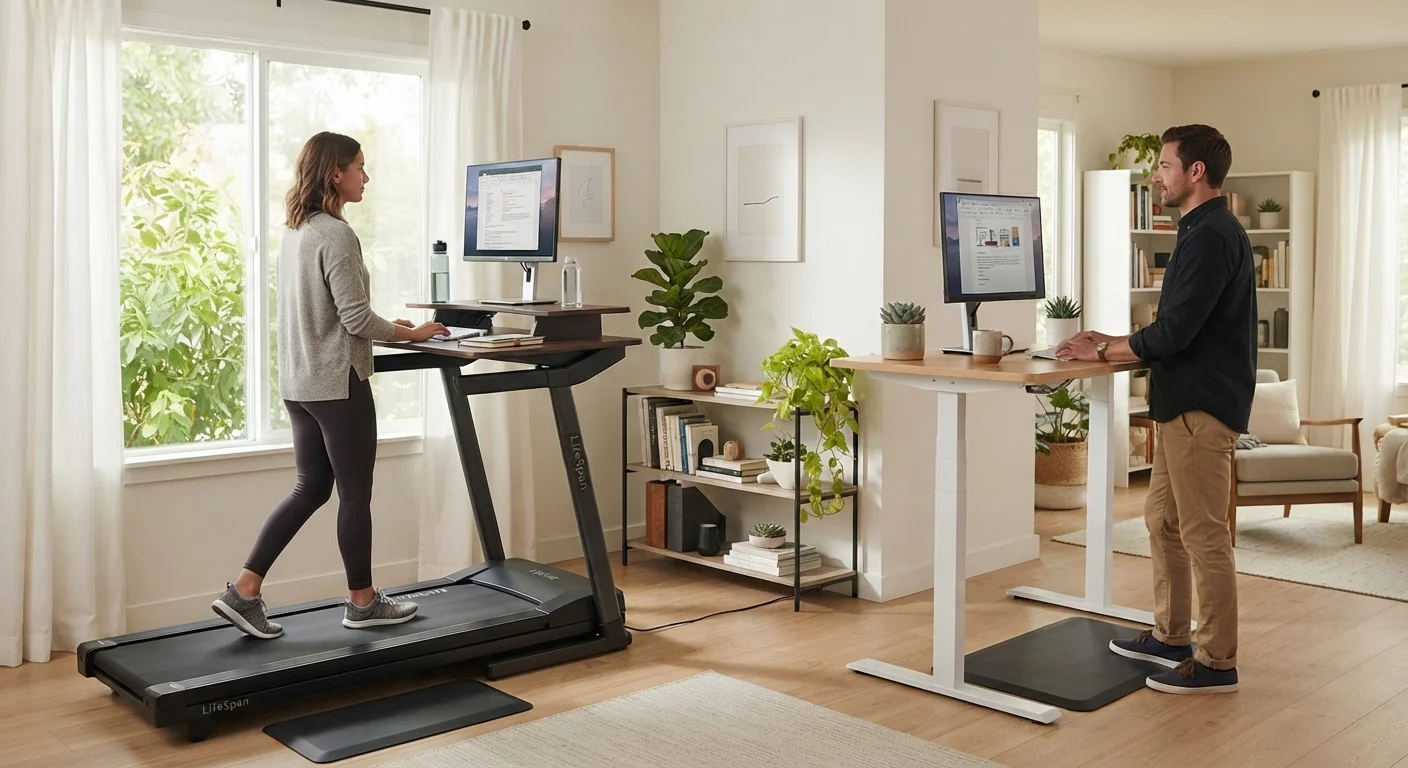
Walking Desks (Treadmill Desks)
The active, movement-first approach to desk work.
Best for: Workers who want genuine low-intensity movement throughout the day and can tolerate a learning curve with typing and concentration.
Option B
Standing Desks (Height-Adjustable Desks)
The accessible, flexible upgrade to a seated workstation.
Best for: People looking to reduce continuous sitting time with minimal disruption to their existing workflow and focus tasks.
If your primary goal is reducing uninterrupted sitting time with minimal workflow disruption
Standing Desks
A height-adjustable desk lets you alternate between sitting and standing easily throughout the day without interrupting complex tasks or requiring coordination adjustments.
If you want to increase daily movement and light physical activity during work hours
Walking Desks
Even slow treadmill walking meaningfully elevates heart rate, increases caloric burn, and engages muscles in a way that standing alone does not.
If you have budget constraints or limited workspace
Standing Desks
Height-adjustable desks are significantly more affordable and space-efficient than treadmill desk setups, making them a practical starting point.
If you perform largely routine, low-cognitive-demand tasks during the workday
Walking Desks
Tasks like answering emails or attending audio-only meetings can be done comfortably at slow walking speeds once you adapt to the setup.
If you have existing lower-limb, joint, or balance concerns
Standing Desks
Standing desks offer movement variety without the coordination demands of walking; always consult a healthcare professional before making changes if you have physical limitations.
Why Breaking Up Sitting Matters More Than You Might Think
Most office workers sit for six to eight hours a day - and formal exercise sessions, however consistent, may not fully offset the metabolic effects of that sustained inactivity. Research increasingly distinguishes between sedentary time (total hours spent sitting) and physical inactivity (absence of structured exercise), treating them as separate risk factors for cardiovascular disease, type 2 diabetes, and musculoskeletal problems.
Prolonged sitting affects more than your posture - it disrupts glucose regulation and reduces circulation in ways that short walks can meaningfully counter. This is where both walking desks and standing desks enter the conversation: not as replacements for exercise, but as tools for interrupting sedentary patterns during the workday itself.
What Standing Desks Actually Do - and Don't Do
Height-adjustable standing desks allow workers to shift between sitting and standing throughout the day. The appeal is straightforward: stand more, sit less. And they do deliver on that narrow promise - regular use reduces total daily sitting time, which is a meaningful improvement over an entirely seated workday.
However, standing is not the same as moving. The metabolic difference between sitting and standing quietly is modest - studies suggest standing burns only marginally more calories per hour than sitting. More importantly, standing for long, unbroken stretches introduces its own problems: lower-limb fatigue, varicose vein risk, and lower-back discomfort are well-documented if posture and duration aren't managed carefully. Switching to a standing desk doesn't automatically fix posture problems - and can introduce new ones.
The strongest evidence supports alternating between sitting and standing rather than simply replacing one with the other. A commonly cited guideline suggests breaking up every 30 minutes of sitting with a posture change, though exact timing should reflect individual comfort.
| Criterion | Walking Desk | Standing Desk |
|---|---|---|
| Primary benefit | Continuous low-intensity movement | Reduced uninterrupted sitting time |
| Caloric expenditure vs. sitting | Moderately higher | Marginally higher |
| Cardiovascular stimulus | Mild but meaningful | Minimal |
| Workflow disruption | Initial learning curve required | Very low - easy to switch |
| Space required | Significant (treadmill footprint) | Same as standard desk |
| Typical cost | Higher (desk + treadmill unit) | Lower (frame only) |
| Joint/fatigue considerations | Lower-limb impact over long sessions | Leg fatigue, back strain if overused |
| Best task compatibility | Routine, lower-demand tasks | All task types |
What Walking Desks Add to the Picture
Treadmill desks - workstations mounted over a slow-moving treadmill belt - go a step further by replacing sedentary or static time with genuine low-intensity movement. Even at the slow speeds typically used for desk work (around 1-2 mph), walking engages leg muscles, raises heart rate modestly above resting, and meaningfully increases caloric expenditure compared to sitting or standing.
Small but well-designed studies have shown that walking desk use can improve markers of blood glucose regulation and reduce waist circumference over time. The movement is continuous rather than episodic, which matters for sustaining metabolic benefits across the workday.
The trade-offs are real. Walking while working demands a coordination adjustment, and fine motor tasks - detailed writing, precise mouse work, video calls requiring steady posture - can be harder to execute well at first. There is also the practical barrier of cost and space: treadmill desk setups require considerably more floor space and financial investment than a height-adjustable frame.
~88 kcal/hr
Extra calories burned walking slowly vs. sitting
A study published in the Journal of Physical Activity and Health estimated treadmill desk use at 1-2 mph burns roughly 88 more calories per hour than seated work.
9-10 hrs
Average daily sitting time for office workers
Research consistently estimates office-based workers sit for nine to ten hours daily, making workday movement interventions especially relevant.
~2 kcal/hr
Extra calories burned standing vs. sitting
A 2013 analysis in the European Journal of Preventive Cardiology found the difference between sitting and quiet standing to be very small - approximately 2 additional calories per hour.
Choosing the Right Tool for Your Workday
Neither option is universally superior. The right choice depends on your job tasks, physical condition, workspace, and how you realistically use equipment over weeks and months - not just on day one.
If your work involves extended deep-focus tasks (coding, writing, detailed analysis), a standing desk lets you shift posture without sacrificing concentration. If your day includes stretches of routine, lower-demand work, a walking desk can convert that time into light activity without meaningful productivity loss once you've adapted.
Importantly, both tools are more effective when embedded in a broader movement strategy rather than used as complete solutions. Realistic strategies for introducing more movement into a sedentary workday can help you build a sustainable system around whichever desk setup you choose.
If you're deciding between the two approaches to exercise format more broadly, seated and standing workouts each offer real benefits - the same principle of matching format to your current ability and context applies here.
Both Tools Work Best in Combination
Research on sedentary behavior consistently shows that variety - alternating sitting, standing, and walking - produces better outcomes than any single posture maintained all day. Think of these desks as tools that support a movement habit, not replacements for it. Even without a specialist desk, scheduled movement breaks every 30 minutes can deliver meaningful benefits. The real benefits and limitations of standing versus sitting are worth understanding before investing in either setup.
This article is for general informational purposes only and is not a substitute for professional medical or ergonomic advice. If you have existing musculoskeletal conditions, cardiovascular concerns, or balance issues, consult a qualified healthcare professional before making changes to your workstation setup or physical activity level.