

| Typical sleep cycle length | ~90 minutes (American Academy of Sleep Medicine) |
| Cycles per night (adults) | 4-6 cycles |
| N2 share of total sleep | ~45-55% (National Sleep Foundation) |
| N3 (deep sleep) dominates | Early-night cycles |
| REM sleep dominates | Late-night cycles |
| Growth hormone release | Primarily during N3 (deep sleep) |
How Sleep Is Structured
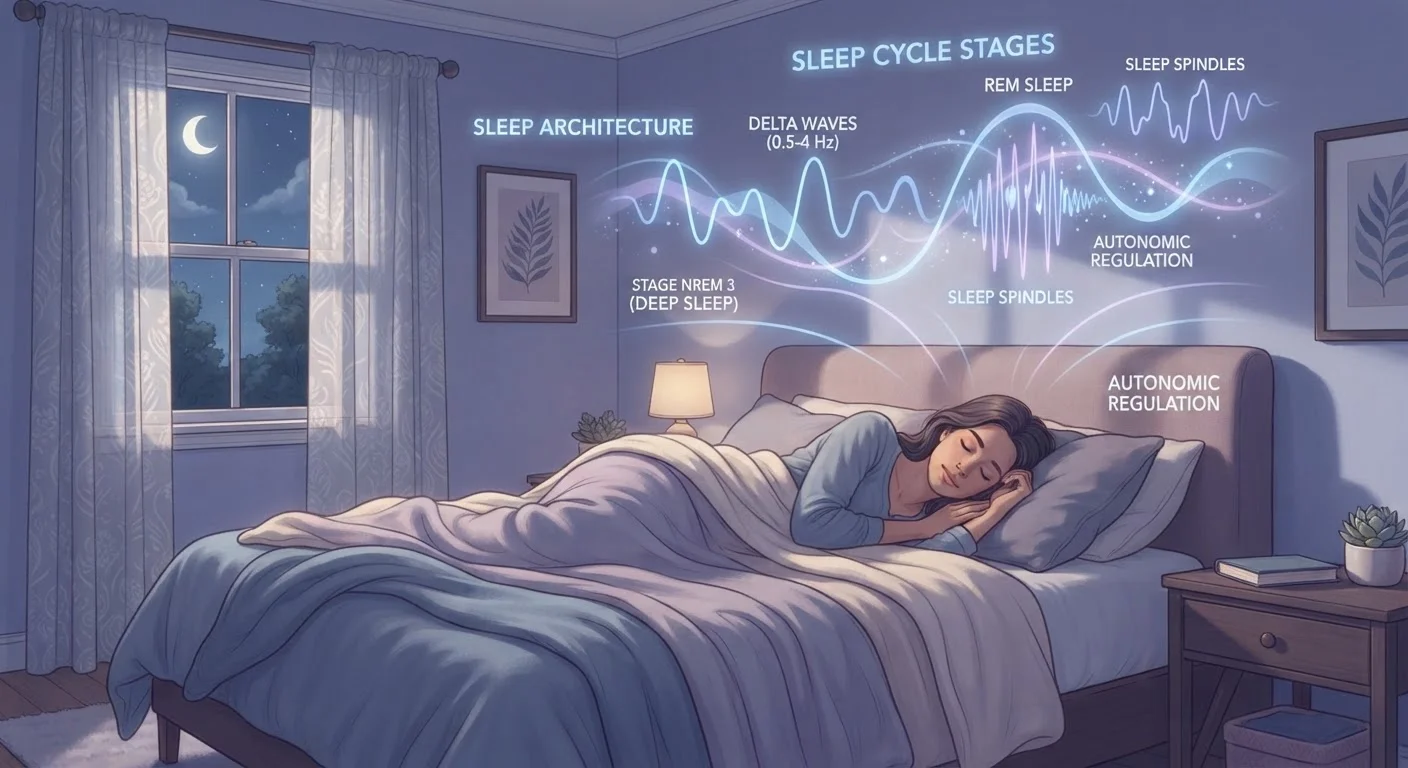
Sleep is not a single, uniform state of unconsciousness. Each night, your brain moves through a repeating sequence of stages organized into cycles that last roughly 90 minutes. A typical adult completes four to six of these cycles per night. Understanding the architecture of those cycles is the foundation of understanding why a full night of sleep does so much more than simply resting your eyes.
Sleep researchers divide sleep into two broad categories: non-REM sleep (NREM) and REM sleep (rapid eye movement). NREM sleep is further split into three stages - N1, N2, and N3 - each progressively deeper than the last. Together, these four stages make up a single complete cycle.
| Typical sleep cycle length | ~90 minutes (American Academy of Sleep Medicine) |
| Cycles per night (adults) | 4-6 cycles |
| N2 share of total sleep | ~45-55% (National Sleep Foundation) |
| N3 (deep sleep) dominates | Early-night cycles |
| REM sleep dominates | Late-night cycles |
| Growth hormone release | Primarily during N3 (deep sleep) |
For a deeper look at what your body is doing during each of these stages, see what actually happens to your body while you sleep.
The Four Stages Explained
Stage N1 - Light Sleep (Transition)
N1 is the entry point into sleep, typically lasting just one to seven minutes. Muscle activity slows, eye movements taper off, and the brain begins shifting from waking alpha waves to slower theta waves. This is the stage where hypnic jerks - those sudden muscle twitches many people experience as they drift off - tend to occur. N1 accounts for only a small fraction of total sleep time and is the stage from which you're most easily woken.
Stage N2 - Light-to-Moderate Sleep
N2 makes up the largest portion of a typical night's sleep, often around 45-55% of total sleep time. Body temperature drops, heart rate slows, and the brain generates bursts of activity called sleep spindles and K-complexes - electrical patterns researchers associate with memory consolidation and the brain's ability to filter out external stimuli. You're harder to wake during N2 than N1, and your body is beginning meaningful restorative work.
Stage N3 - Deep Sleep (Slow-Wave Sleep)
N3 is the deepest and most physically restorative stage. Brain activity slows to long, synchronized delta waves, breathing becomes steady, and blood pressure drops. This is when the body releases growth hormone, repairs tissue, strengthens the immune system, and consolidates certain types of memory. Deep sleep is hardest to wake from - if disturbed, most people feel groggy and disoriented, a state called sleep inertia. N3 dominates early cycles of the night.
REM Sleep - The Brain's Nightly Reboot
REM sleep is defined by rapid eye movements, near-paralysis of the voluntary muscles, and brain activity that closely resembles wakefulness. Most vivid dreaming occurs here. REM is essential for emotional processing, creative problem-solving, and the consolidation of procedural and emotional memories. REM periods grow longer in the final cycles of the night, which is why cutting sleep short consistently can disproportionately reduce REM time.
NREM Sleep
Non-rapid eye movement sleep. The portion of sleep divided into three stages (N1, N2, N3) that precedes REM sleep in each cycle. NREM sleep is generally associated with physical restoration.
REM Sleep
Rapid eye movement sleep. A distinct sleep stage characterized by active brain patterns, vivid dreaming, and muscle atonia. Critical for memory consolidation and emotional regulation.
Sleep Spindles
Brief bursts of oscillating brain activity that occur during N2 sleep. They are thought to play a role in blocking sensory input and supporting memory consolidation.
Slow-Wave Sleep
Another term for N3 or deep sleep, named for the slow, high-amplitude delta brain waves dominant during this stage. The most physically restorative phase of the sleep cycle.
Sleep Inertia
The groggy, disoriented feeling that occurs when a person is woken from deep sleep. It reflects the brain's difficulty transitioning abruptly from slow-wave to waking activity.
Sleep Cycle
One complete progression through all four sleep stages (N1, N2, N3, and REM), lasting roughly 90 minutes. A full night's sleep typically includes four to six cycles.
Why the Balance Between Stages Matters
No single stage of sleep is expendable. Deep sleep (N3) prioritizes physical repair; REM sleep prioritizes cognitive and emotional recovery. Disrupting one doesn't leave the other to compensate entirely - they serve different biological functions through different mechanisms.
~25%
Of total sleep time spent in REM
According to the National Sleep Foundation, healthy adults typically spend roughly 20-25% of their nightly sleep in REM.
~13-23%
Of total sleep time spent in deep sleep (N3)
Deep sleep proportions naturally decline with age, making sleep quality increasingly important in older adults.
1-2 hrs
Of REM lost by cutting sleep short by 90 min
Because REM periods lengthen in the final sleep cycles, even modest sleep curtailment can significantly reduce REM time.
Early-night sleep cycles are weighted heavily toward deep sleep. Late-night cycles are weighted toward REM. This is why sleeping in consistent, uninterrupted blocks - rather than fragmenting sleep across short naps - allows the brain to complete its full biological programme. For age-specific guidance on how much sleep different people need, see sleep needs across the lifespan.
If you're new to thinking seriously about sleep quality, getting started with better sleep offers practical, judgement-free fundamentals. And for a fuller picture of the biology at work each night, explore sleep cycles decoded.
This article is for general informational purposes only and is not a substitute for professional medical advice. If you have concerns about your sleep quality or health, please consult a qualified healthcare professional.