

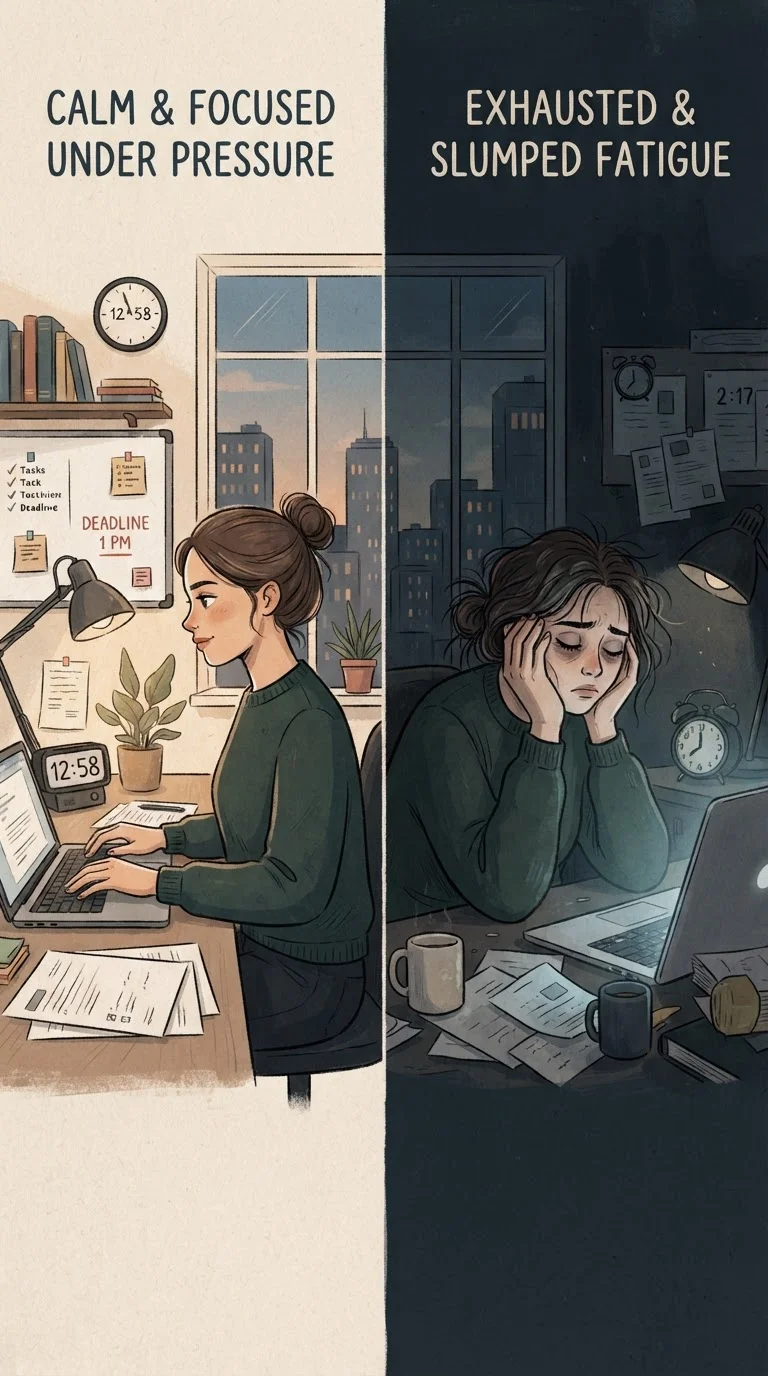
Key Takeaways
Option A
Acute Stress
The short-lived, survival-wired response.
Best for: Understanding momentary stress spikes triggered by specific events or situations.
Option B
Chronic Stress
The slow-burn threat that accumulates over time.
Best for: Recognizing the ongoing, low-level tension that can quietly affect long-term health.
If your stress is tied to a specific, upcoming event
Acute Stress
Recognizing it as acute helps you use short-term coping tools - like deep breathing or time-boxing tasks - and trust that relief follows resolution.
If stress feels constant with no clear off switch
Chronic Stress
Naming it as chronic shifts your approach toward sustainable habit changes and professional support rather than waiting it out.
If you want to understand long-term health risks
Chronic Stress
Chronic stress carries compounding effects on cardiovascular health, immunity, and sleep - making early recognition and management particularly important.
Two Types of Stress, Two Very Different Stories
Stress is often talked about as a single experience - something to reduce, manage, or eliminate. But the term covers two fundamentally different states: acute stress and chronic stress. Treating them the same way can leave you using the wrong tools for the job.
Acute stress is the immediate, short-term response your body fires off when it senses a threat or demand - a job interview, a near-miss in traffic, a tough conversation. Chronic stress, by contrast, is what happens when that same alarm system stays switched on for weeks, months, or even years without meaningful recovery time.
Understanding the biology behind your stress response can help you make sense of why both feel so physical - and so draining.
How Each Type Works in Your Body
Both acute and chronic stress activate what's known as the hypothalamic-pituitary-adrenal (HPA) axis - a network involving the brain and adrenal glands that releases hormones like cortisol and adrenaline. These hormones sharpen focus, raise heart rate, and redirect energy to muscles. That's useful in a pinch.
With acute stress, this response is self-limiting. Once the stressor passes, hormone levels drop, your heart rate slows, and your body returns to baseline. The system works as designed.
Chronic stress disrupts that recovery cycle. When stressors don't resolve - financial strain, caregiving pressure, job insecurity, relationship conflict - cortisol stays elevated. Over time, this sustained activation begins to interfere with systems not built for long-running emergencies.
| Criterion | Acute Stress | Chronic Stress |
|---|---|---|
| Duration | Minutes to days | Weeks to months or longer |
| Trigger | Specific, identifiable event | Ongoing or unresolved pressures |
| Cortisol pattern | Spikes, then returns to baseline | Stays elevated, disrupts recovery |
| Health impact | Generally manageable; can sharpen focus | Associated with inflammation, sleep disruption, cardiovascular risk |
| Typical management approach | In-the-moment coping techniques | Lifestyle changes and professional support |
| Recovery | Natural and relatively quick | Requires deliberate, sustained effort |
See what actually happens in your body during a stress response for a plain-language breakdown of these hormonal shifts.
Real-World Differences in Cause and Duration
Acute stress tends to have a clear source and a natural endpoint. Public speaking, a medical appointment, a deadline - these are bounded events. Even intense acute stress often fades within hours or a day or two.
Chronic stress sources are usually ongoing and harder to pinpoint or resolve. They include structural pressures - poverty, discrimination, chronic illness, long-term conflict - as well as sustained lifestyle factors like overwork and social isolation. Because the stressor doesn't go away, neither does the response.
It's also worth noting that frequent acute stress episodes can themselves tip into chronic stress if recovery time is consistently cut short. A person who faces repeated intense stressors day after day may experience effects similar to someone under prolonged, lower-level tension.
Stress Can Shift Categories Over Time
Acute and chronic stress aren't always cleanly separate. Repeated acute stressors - with insufficient downtime between them - can produce effects similar to chronic stress. Likewise, chronic stress may involve acute spikes on top of an already elevated baseline. Paying attention to patterns over time, not just individual moments, gives a more accurate picture of what your body is managing.
For a deeper look at how prolonged stress compounds over time, explore the science of chronic stress.
Why the Distinction Matters for Your Health
Acute stress, in controlled doses, is not inherently harmful. Research suggests that brief, manageable stress episodes can sharpen attention and even support immune function in the short term. This is sometimes described as eustress - stress that challenges without overwhelming.
Chronic stress is a different matter. Sustained cortisol elevation is associated with increased inflammation, disrupted sleep, impaired immune response, and greater cardiovascular risk. Learn what chronic stress actually does to your body for a fuller picture of these downstream effects.
77%
Adults reporting physical symptoms of stress
According to the American Psychological Association's Stress in America survey, a large majority of U.S. adults report experiencing physical symptoms they associate with stress.
3x
Elevated cardiovascular risk with chronic stress
Research published in health literature suggests individuals with sustained high stress may face significantly elevated risk factors for cardiovascular events compared to low-stress counterparts.
Identifying which type you're dealing with matters because the responses differ. Acute stress calls for in-the-moment regulation tools - breathing exercises, grounding techniques, brief physical movement. Chronic stress typically requires more systemic changes: improved sleep habits, boundary-setting, consistent social support, and, in many cases, professional guidance.
If you're unsure whether your stress has crossed from acute to chronic - or if it overlaps with anxiety - understanding the difference between anxiety and stress may also help clarify what you're experiencing.
This article is for general informational purposes only and is not a substitute for professional medical or mental health advice. If stress is significantly affecting your daily life, please speak with a qualified healthcare provider.