

Key Takeaways
Backed by decades of peer-reviewed research
GI has been studied extensively since the 1980s and is recognised by major diabetes and nutrition organisations as a valid dietary reference tool.
Helps identify blood-sugar-friendly carbohydrate choices
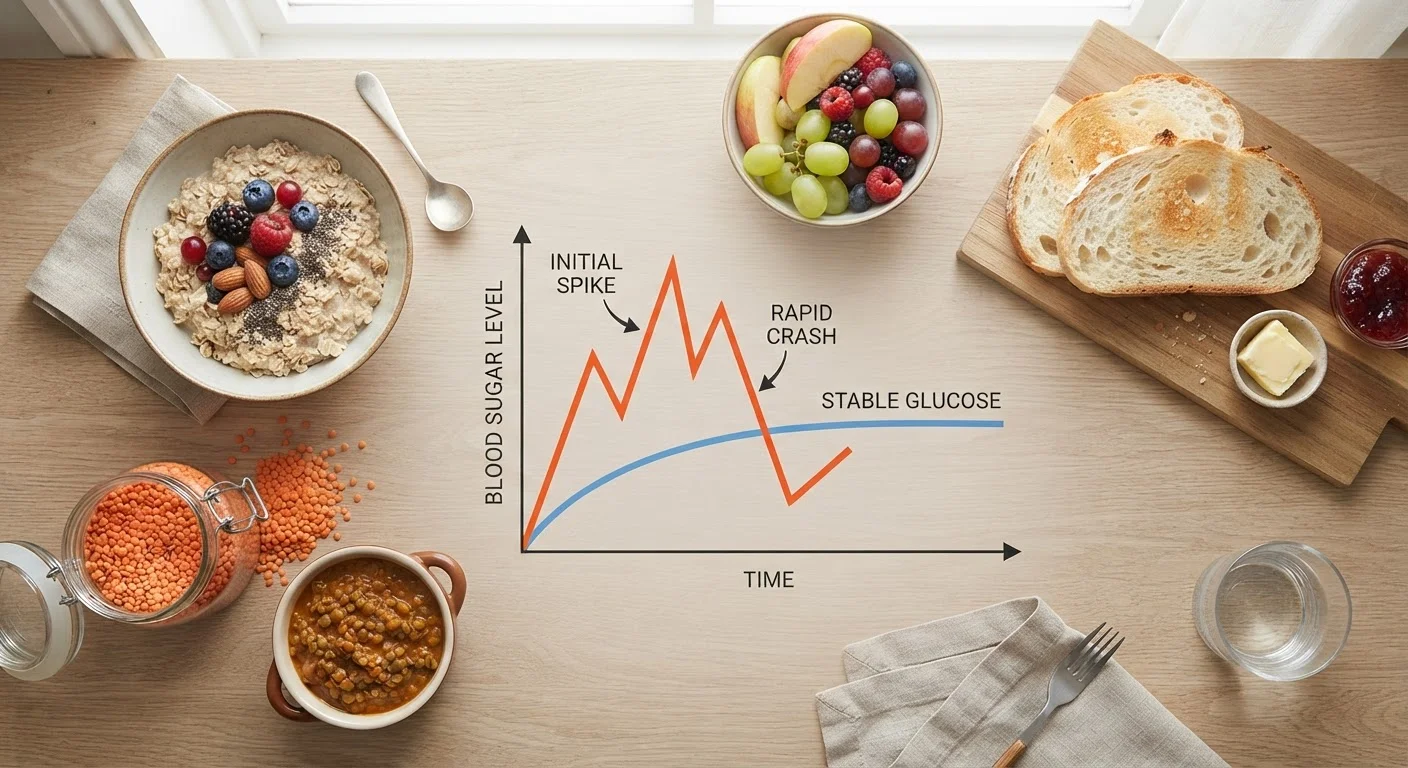
Choosing lower-GI foods - such as legumes, oats, and most non-starchy vegetables - is consistently associated with more stable postmeal glucose levels.
Can support weight and appetite management
Some research suggests lower-GI foods promote greater satiety, potentially reducing overall calorie intake, though this effect varies between individuals.
Provides a structured framework for carbohydrate quality
Rather than eliminating carbohydrates entirely, GI encourages a qualitative approach - shifting toward whole grains, pulses, and fibre-rich options.
Ignores portion size entirely
A food can have a high GI but deliver very little total carbohydrate per realistic serving, making its actual blood sugar impact quite modest. This is why glycaemic load is often the more actionable metric.
Food combinations dramatically change the outcome
Adding fat, protein, or fibre to a high-GI food significantly slows glucose absorption. A white potato eaten with chicken and salad behaves very differently than a plain baked potato consumed alone.
Significant individual variation exists
Research, including work published in the journal Cell, has shown that blood glucose responses to identical foods can differ substantially between people based on gut microbiome, genetics, and metabolic health.
Cooking and ripeness alter GI scores
The GI of pasta increases with cooking time; a ripe banana has a meaningfully higher GI than an underripe one. The score printed in a table may not match the food on your plate.
Can create a misleading 'healthy halo' for low-GI junk foods
Some highly processed foods score low on the GI scale due to their fat content - chocolate and crisps, for example - which can mislead consumers focused solely on the GI number.
Our Verdict
The glycaemic index offers genuine value as a starting point for understanding how carbohydrates affect blood sugar, but it works best as one tool among several rather than a rigid dietary rulebook. Its limitations - particularly around portion size, food combinations, and individual variation - mean it should be interpreted with context rather than followed mechanically.
GI is most useful for people managing blood sugar conditions such as type 2 diabetes or prediabetes, and for anyone looking to build a more informed foundation in nutrition science - always in consultation with a registered dietitian or healthcare provider.
What the Glycaemic Index Actually Measures
The glycaemic index (GI) is a numerical scale from 0 to 100 that ranks carbohydrate-containing foods based on how quickly they raise blood glucose (blood sugar) levels compared to pure glucose or white bread, which serve as the reference standard. Foods scoring 55 or below are considered low GI, 56-69 moderate, and 70 or above high GI.
The system was developed in the early 1980s as a clinical research tool, primarily to help people with diabetes make more informed carbohydrate choices. Today it appears on food packaging, in diet plans, and across nutrition conversations - often without the nuance it deserves.
To understand GI's strengths and weaknesses, it helps to first have a solid grasp of how carbohydrates work in your body. Our guide on simple vs. complex carbohydrates walks through that foundation clearly.
GI vs. Glycaemic Load: Know the Difference
GI measures how fast a food raises blood sugar, but it says nothing about how much carbohydrate a typical serving contains. Glycaemic load (GL) combines both factors and is generally considered a more practical metric for everyday food decisions. Neither replaces overall dietary balance, but together they offer more nuance than GI alone.
The Case For Using GI
Despite its limitations, GI has a well-established evidence base and genuine practical utility when used appropriately.
Backed by decades of peer-reviewed research
GI has been studied extensively since the 1980s and is recognised by major diabetes and nutrition organisations as a valid dietary reference tool.
Helps identify blood-sugar-friendly carbohydrate choices
Choosing lower-GI foods - such as legumes, oats, and most non-starchy vegetables - is consistently associated with more stable postmeal glucose levels.
Can support weight and appetite management
Some research suggests lower-GI foods promote greater satiety, potentially reducing overall calorie intake, though this effect varies between individuals.
Provides a structured framework for carbohydrate quality
Rather than eliminating carbohydrates entirely, GI encourages a qualitative approach - shifting toward whole grains, pulses, and fibre-rich options.
For people managing conditions such as type 2 diabetes or insulin resistance, GI can be a useful framework for selecting carbohydrate sources that produce a more gradual blood sugar response. Learn more about why blood sugar management matters in our overview of how type 2 diabetes develops.
The Case Against Relying on GI Alone
GI scores are generated under tightly controlled laboratory conditions - fasted subjects consuming a fixed 50-gram carbohydrate portion of a single food. Real eating rarely looks like that.
Ignores portion size entirely
A food can have a high GI but deliver very little total carbohydrate per realistic serving, making its actual blood sugar impact quite modest. This is why glycaemic load is often the more actionable metric.
Food combinations dramatically change the outcome
Adding fat, protein, or fibre to a high-GI food significantly slows glucose absorption. A white potato eaten with chicken and salad behaves very differently than a plain baked potato consumed alone.
Significant individual variation exists
Research, including work published in the journal Cell, has shown that blood glucose responses to identical foods can differ substantially between people based on gut microbiome, genetics, and metabolic health.
Cooking and ripeness alter GI scores
The GI of pasta increases with cooking time; a ripe banana has a meaningfully higher GI than an underripe one. The score printed in a table may not match the food on your plate.
Can create a misleading 'healthy halo' for low-GI junk foods
Some highly processed foods score low on the GI scale due to their fat content - chocolate and crisps, for example - which can mislead consumers focused solely on the GI number.
~20%
Variation in GI between individuals for the same food
Research published in Cell (Zeevi et al., 2015) found that postmeal glucose responses varied significantly between people eating identical standardised meals.
55 or below
GI threshold classified as 'low'
This threshold is used by organisations including Diabetes UK and the American Diabetes Association as a general guideline for carbohydrate selection.
For a broader grounding in the nutrition vocabulary surrounding GI - including terms like glycaemic load and dietary fibre - see our nutrition glossary.
Glycaemic Load: A More Practical Companion
Glycaemic load (GL) addresses one of GI's biggest blind spots: portion size. GL is calculated by multiplying a food's GI score by the number of grams of carbohydrate in a typical serving and dividing by 100. This produces a figure that reflects both the quality and quantity of carbohydrate consumed.
Watermelon illustrates this well. It has a high GI (~72) because its sugars are rapidly absorbed, but a standard serving contains relatively few carbohydrates, giving it a low GL. Judged by GI alone, it looks like a food to avoid. Factored for realistic portions, it looks quite different.
When evaluating packaged foods, pairing your understanding of GI with label literacy adds another layer of context. Our guide to reading a nutrition label can help you put the numbers in perspective.
This article is for general informational purposes only and does not constitute medical or dietary advice. If you have a health condition or specific nutrition concerns, consult a qualified healthcare professional or registered dietitian.