

Key Takeaways
Social Exercise Effect
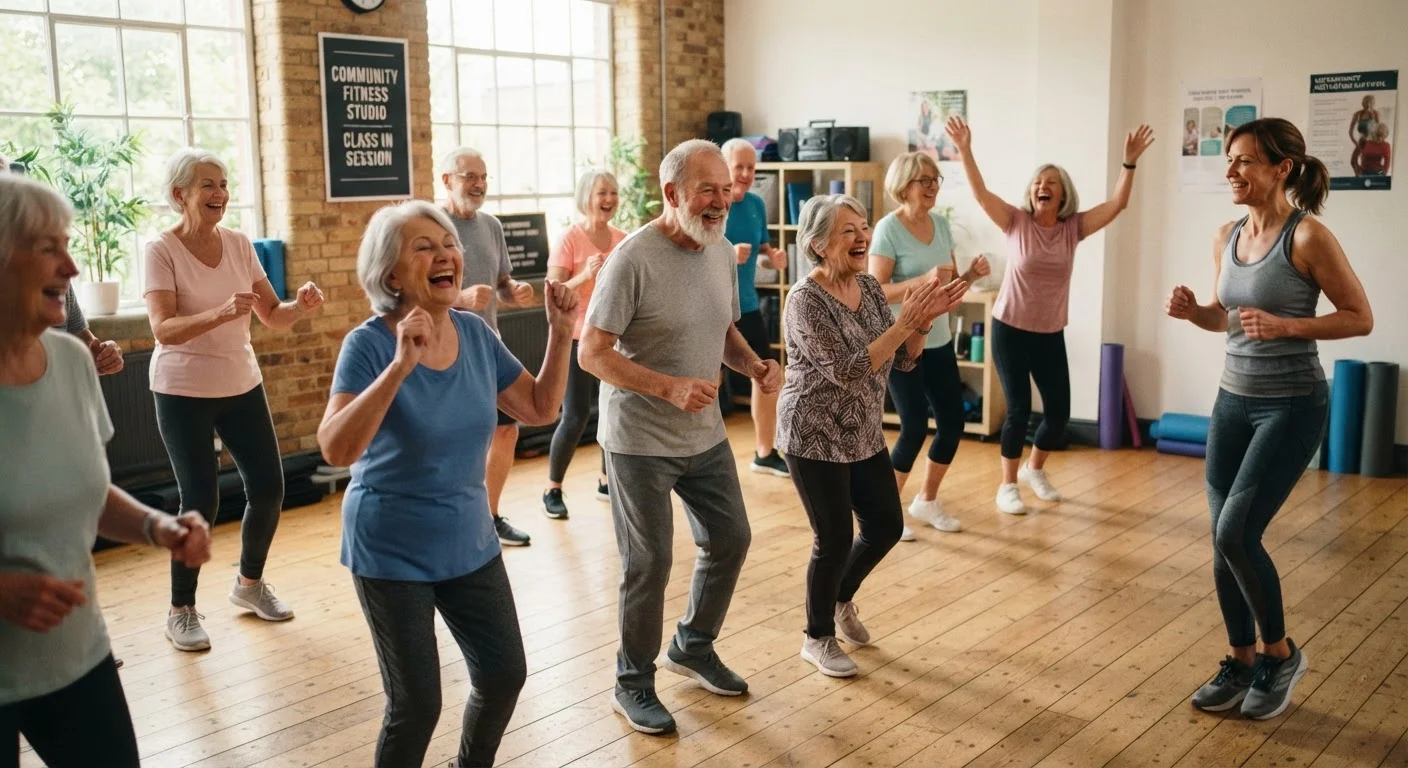
The "social exercise effect" refers to the additional health benefits that come from working out alongside other people, beyond what solo exercise provides. When older adults participate in group fitness classes, they gain not only the physical gains of movement but also mood boosts, reduced feelings of loneliness, and stronger motivation to stay consistent. These benefits are supported by a growing body of research in exercise science and social health.
Studies in geroscience suggest that social engagement activates overlapping neurobiological pathways with physical activity, compounding benefits for cognitive function and stress regulation in older adults.
More Than Just Moving Together
There's a reason group fitness classes tend to feel different from a solo treadmill session. The energy in a room full of people working toward a common goal - whether it's a water aerobics class at the local pool or a chair yoga session at a senior center - creates something that exercise science is only beginning to fully quantify.
For older adults especially, that social dimension isn't just a nice bonus. It may be a meaningful driver of health outcomes in its own right. As movement needs evolve with age - something explored in depth in our guide on how exercise needs shift from your 50s to your 80s - the context in which exercise happens also matters more than many people realize.
~40%
Reduction in loneliness linked to group activity
Research published in aging and social health journals suggests structured group participation can significantly reduce self-reported loneliness among older adults.
26%
Lower mortality risk with regular social engagement
A meta-analysis of social relationship studies found that adequate social connection was associated with a notably lower risk of early mortality across age groups.
2x
Higher exercise adherence in group vs. solo settings
Behavioral research consistently shows older adults are roughly twice as likely to maintain an exercise habit when classes involve social accountability and peer presence.
What Research Links to Group Exercise
Several well-designed studies have found that older adults who participate in group fitness classes report better mood, higher motivation, and greater consistency compared to those who exercise alone. A study published in the Journal of the American Osteopathic Association found that group exercise participants reported significantly lower stress and higher mental and emotional quality-of-life scores than solo exercisers, even when total exercise volume was similar.
The social contact embedded in group classes also appears to buffer against loneliness - a condition that carries genuine physical health risks. As our article on what the research on loneliness and aging shows explains, social isolation is associated with elevated inflammation, poorer cardiovascular health, and accelerated cognitive decline. Group exercise addresses physical and social health simultaneously.
“Exercise is one of the most powerful tools we have for healthy aging - and when it's social, the benefits compound. Movement with others addresses the body and the mind at the same time.”
— Robert Waldinger, Professor of Psychiatry, Harvard Medical School, and Director of the Harvard Study of Adult Development
The Cognitive Angle: Brain Health and Social Movement
Physical exercise alone has well-documented benefits for brain health in older adults - aerobic activity, in particular, is linked to improved memory and reduced dementia risk. Our detailed breakdown of physical exercise and brain health covers what different forms of movement do for cognition. But emerging research suggests that combining exercise with social interaction may offer an additive benefit.
When you navigate a group class - following an instructor, keeping pace with others, coordinating movement in shared space - you engage attention, coordination, and social processing simultaneously. This kind of multi-domain stimulation is increasingly recognized as valuable for cognitive resilience as we age.
Start With One Class Per Week
If group exercise is new to you, beginning with a single weekly class reduces the pressure to perform and gives you time to find a format and community that feels right. Consistency matters more than frequency at the outset. Many older adults find that once they've established a routine, they naturally add more sessions as confidence and enjoyment grow.
Practical Considerations: Finding the Right Fit
Not every group class is the same, and not every format will suit every individual. The good news is that the range of options has expanded considerably. Community centers, YMCAs, hospital wellness programs, and senior living facilities frequently offer classes designed with older adults in mind - including chair-based formats, aquatic exercise, tai chi, and low-impact aerobics.
The foundational principles of safe, effective movement apply regardless of class format. For a broader framework on building activity into daily life, the Daily Movement hub offers accessible starting points. And for those new to structured exercise, the Workout Basics hub provides grounding in the fundamentals.
This article is for general informational purposes only and is not a substitute for personalized medical advice. Consult a qualified healthcare professional before beginning any new exercise program, especially if you have existing health conditions.