

| Primary transmission categories | Airborne, droplet, contact (direct and indirect) (CDC Infection Control Guidelines) |
| Airborne particle size | < 5 micrometers (can linger for hours) (WHO, 2021) |
| Droplet effective range | Approximately 3-6 feet from source (CDC infection control standards) |
| Key airborne example | Measles, tuberculosis, chickenpox |
| Key droplet example | Influenza, whooping cough |
| Key contact (fomite) example | Norovirus, RSV |
Why Transmission Routes Matter
When a pathogen spreads from one person to another, it doesn't happen randomly - it follows predictable physical pathways. Knowing which pathway a given infection uses shapes every practical decision about prevention, from whether a mask helps to whether washing your hands is the critical intervention.
This reference breaks down the three major transmission categories recognized in infectious disease medicine: airborne, droplet, and contact. Understanding the distinction can help you interpret public health guidance more clearly. For a broader foundation, see the plain-language overview of how infectious diseases spread.
| Primary transmission categories | Airborne, droplet, contact (direct and indirect) (CDC Infection Control Guidelines) |
| Airborne particle size | < 5 micrometers (can linger for hours) (WHO, 2021) |
| Droplet effective range | Approximately 3-6 feet from source (CDC infection control standards) |
| Key airborne example | Measles, tuberculosis, chickenpox |
| Key droplet example | Influenza, whooping cough |
| Key contact (fomite) example | Norovirus, RSV |
Airborne Transmission
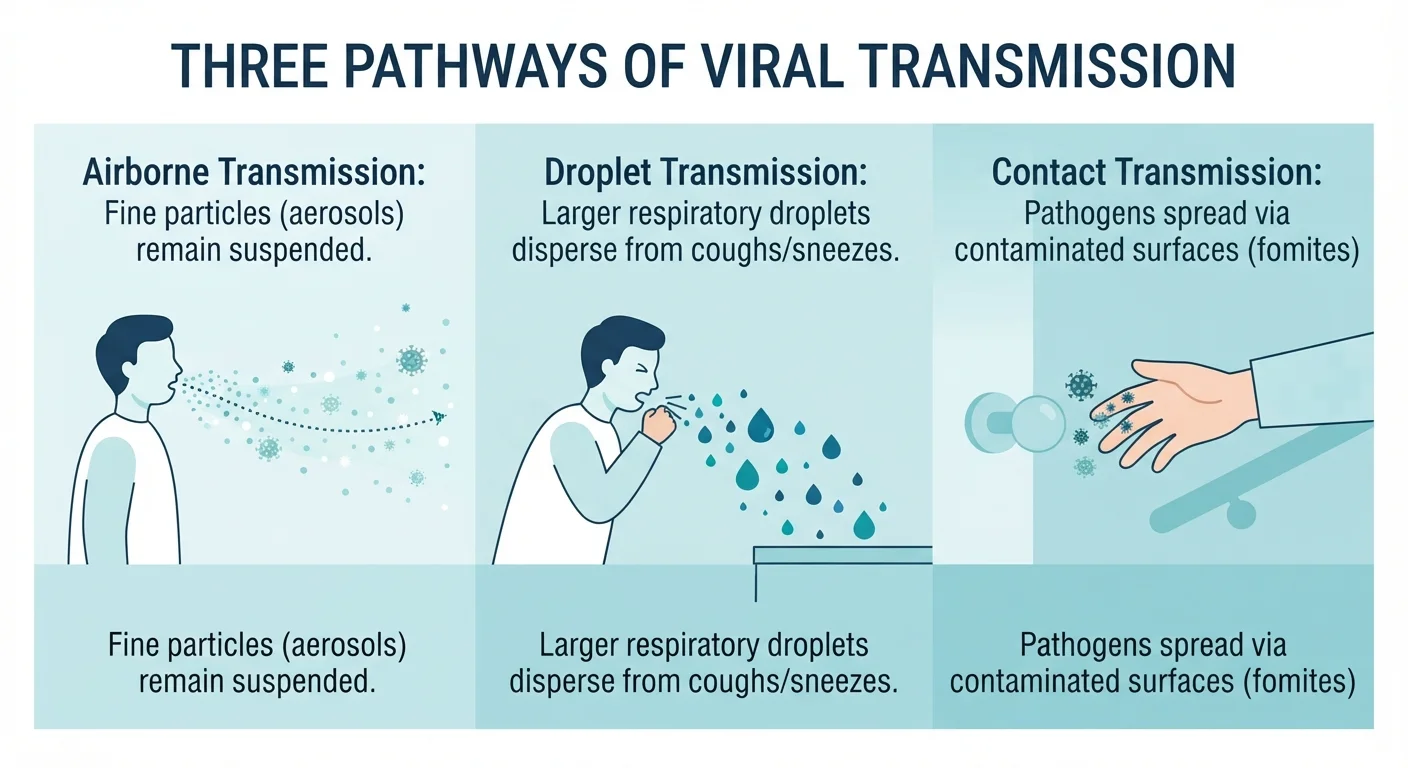
Airborne transmission occurs when tiny infectious particles - called aerosols - remain suspended in the air for minutes to hours and can travel beyond the immediate vicinity of an infected person. These particles are generally smaller than 5 micrometers in diameter, small enough to drift on air currents and linger in enclosed, poorly ventilated spaces.
Classic examples of airborne diseases include measles, tuberculosis, and chickenpox (varicella). Research during and after the COVID-19 pandemic has also reinforced that SARS-CoV-2 is capable of significant airborne spread, particularly indoors.
Because aerosols can accumulate in a room, ventilation is one of the most important preventive tools against airborne pathogens - a point explored in depth in what the evidence says about handwashing, masks, and ventilation.
Aerosol
Microscopic particles or droplets small enough (typically under 5 micrometers) to remain suspended in the air for extended periods. Aerosols can carry infectious pathogens across a room and are central to airborne transmission.
Respiratory Droplet
Larger particles (generally over 5 micrometers) expelled during coughing, sneezing, or talking. They fall to the ground quickly and are the main vehicle for droplet transmission.
Fomite
Any inanimate object or surface that can harbor and transfer infectious agents. Doorknobs, handrails, and shared utensils are common examples.
Mucous Membrane
The moist lining found in areas such as the nose, mouth, and eyes. Many pathogens enter the body by landing on or being rubbed into these surfaces.
Pathogen
Any microorganism - virus, bacterium, fungus, or parasite - capable of causing disease in a host.
Vector-borne Transmission
A distinct transmission route in which an intermediate organism, such as a mosquito or tick, carries and delivers a pathogen to a human host. This differs from the airborne, droplet, and contact routes.
Droplet Transmission
Droplet transmission involves larger respiratory particles - typically greater than 5 micrometers - propelled into the air when an infected person coughs, sneezes, talks, or breathes. Unlike aerosols, these droplets fall relatively quickly due to gravity, usually within about 3 to 6 feet of the source, and do not remain suspended for long.
Influenza, whooping cough (pertussis), and some strains of rhinovirus (the common cold) spread primarily via droplets. The distinction between droplet and airborne routes matters for determining protective measures: respiratory droplets are less likely to accumulate across a large room but can deposit directly on mucous membranes - the eyes, nose, and mouth - of nearby individuals.
~90%
Attack rate for measles in unvaccinated people exposed to the virus
Measles is one of the most contagious airborne diseases known; the CDC cites attack rates near 90% among susceptible individuals in the same space.
3-6 ft
Typical droplet travel distance before falling
Standard infection control guidance from the CDC and WHO defines the droplet zone as the area within roughly 3 to 6 feet of an infected individual.
Up to 72 hrs
Survival time of some viruses on hard surfaces
Research has shown that certain viruses, including some coronaviruses, can remain detectable on hard surfaces for up to 72 hours, supporting the relevance of fomite transmission.
Contact Transmission: Direct and Indirect
Contact transmission is divided into two subtypes. Direct contact requires physical touching of an infected person - such as a handshake, kiss, or skin-to-skin contact. Infections spread this way include herpes simplex virus and certain staphylococcal skin infections.
Indirect contact - also called fomite transmission - occurs when a person touches a contaminated surface or object and then transfers the pathogen to their own mucous membranes. Norovirus and respiratory syncytial virus (RSV) are well-documented examples. Hand hygiene is the cornerstone of interrupting contact-based spread. For a look at which pathogens are behind common illnesses, the guide to common infections and their pathogens offers a useful reference.
It's also worth noting that some pathogens use more than one route simultaneously, which is why layered prevention strategies are often recommended. For context on the broader infectious disease picture, Infectious Diseases From Start to Finish covers transmission alongside immunity and recovery.
This article is for general informational purposes only and does not constitute medical advice. Always consult a qualified healthcare professional for guidance related to your personal health situation.