

Key Takeaways
Disease Transmission
Disease transmission is the process by which a pathogen - a virus, bacterium, fungus, or parasite - moves from one host to another and causes infection. Different pathogens use different routes, which is why the right prevention strategy depends on knowing how a specific illness actually spreads. Understanding transmission is the foundation of public health.
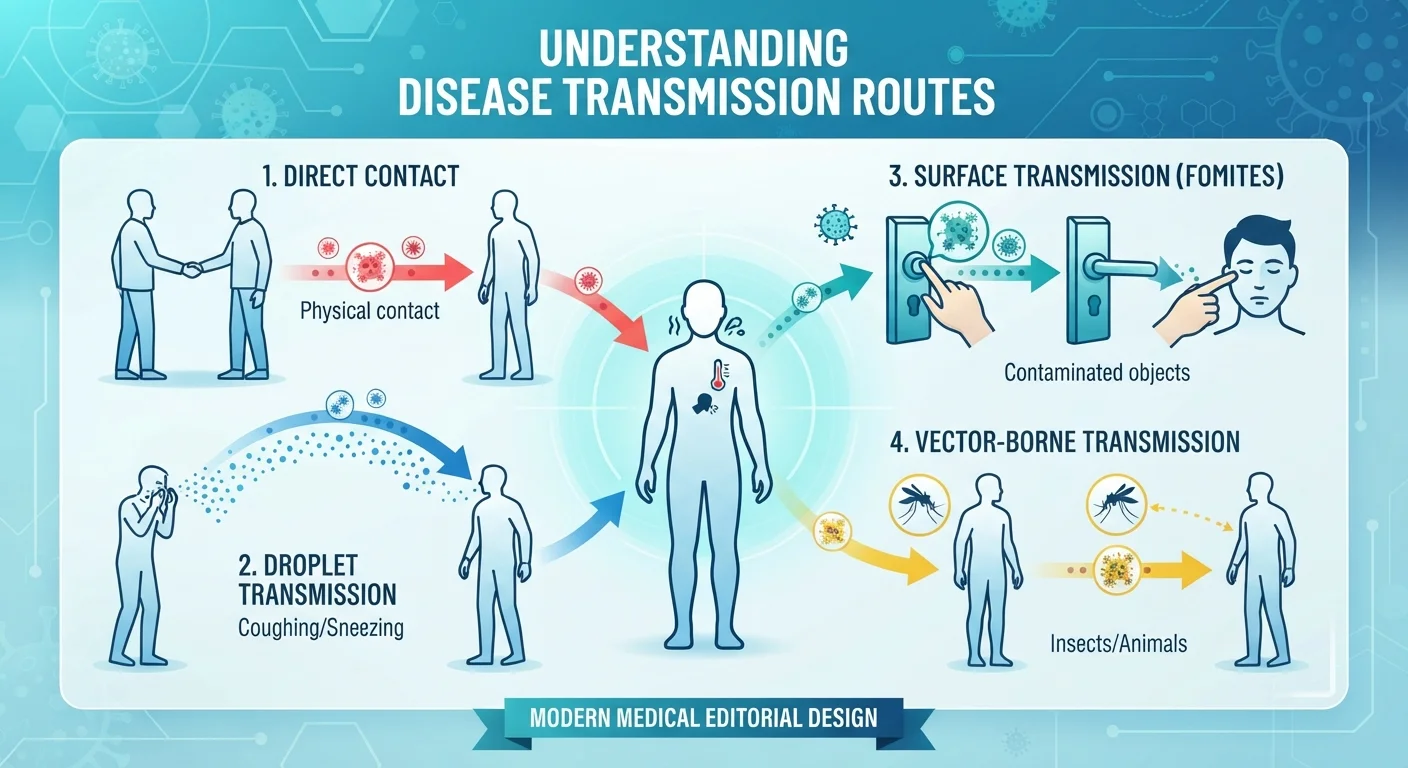
Epidemiologists classify transmission as direct (requiring physical contact or close proximity) or indirect (involving an intermediate vehicle such as a contaminated surface, air current, water, food, or arthropod vector).
Why Transmission Routes Matter
When a new illness circulates in a community, the first question public health officials ask is not just what caused it - but how it moves. The transmission route shapes everything: which populations are most at risk, which interventions work, and how quickly an outbreak can grow.
Pathogens - the organisms that cause infectious disease - are extraordinarily diverse. Viruses, bacteria, fungi, and parasites each have biological properties that favor certain routes of travel over others. For a fuller picture of the organisms involved, see our guide to common infections and the pathogens behind them.
Broadly, transmission falls into two categories: direct, which requires close or physical contact, and indirect, which involves an intermediate - a surface, water supply, food, or living carrier. Most pathogens rely on one primary route, though some can exploit several.
“Understanding how diseases spread from person to person is fundamental to preventing them. Without that knowledge, even the best-intentioned interventions can miss their mark entirely.”
— Centers for Disease Control and Prevention, US federal public health agency
The Main Transmission Routes Explained
Respiratory Droplet and Airborne Transmission
When an infected person coughs, sneezes, talks, or breathes, they release particles containing the pathogen. Larger droplets fall quickly and infect people in close proximity - influenza spreads this way. Smaller aerosol particles can linger in poorly ventilated air for extended periods, as seen with tuberculosis and measles. Masks and ventilation target both mechanisms.
Direct Contact Transmission
Some infections require skin-to-skin or mucous membrane contact. Sexually transmitted infections like herpes and syphilis travel this route, as do many skin infections. Cold sores, for instance, spread through direct contact with active lesions.
Indirect Contact (Fomite) Transmission
A fomite is any inanimate object that carries a pathogen - a doorknob, shared towel, or keyboard. Touching a contaminated surface and then touching your eyes, nose, or mouth completes the transmission chain. This route underlies the spread of norovirus and some respiratory viruses.
Fecal-Oral Transmission
Pathogens shed in fecal matter can contaminate water or food and subsequently be ingested. This route is responsible for cholera, typhoid fever, hepatitis A, and many common gastrointestinal infections. Hand hygiene and safe food handling are the primary defenses.
Vector-Borne Transmission
Vectors are living organisms - typically arthropods like mosquitoes, ticks, and fleas - that carry pathogens from one host to another. Malaria, Lyme disease, dengue, and West Nile virus are all vector-borne. Reducing exposure to vectors is a central prevention strategy.
Bloodborne and Vertical Transmission
Bloodborne pathogens such as HIV and hepatitis B and C spread through direct contact with infected blood or certain body fluids. Vertical transmission occurs when a pathogen passes from a pregnant person to the fetus or newborn during pregnancy, labor, or breastfeeding.
~2 million
Annual deaths from waterborne diseases globally
The WHO estimates that contaminated water sources - a key vehicle for fecal-oral transmission - contribute to roughly 2 million deaths per year, predominantly in low-income regions.
700,000+
Annual deaths linked to vector-borne diseases
According to WHO data, vector-borne diseases account for more than 700,000 deaths each year, with malaria alone responsible for the majority of that toll.
80%
Reduction in infection risk from proper hand hygiene
The CDC notes that regular handwashing can reduce the risk of respiratory and diarrheal illnesses by up to 80%, directly interrupting multiple transmission routes.
Putting Prevention in Context
Knowing the route helps decode prevention recommendations. Respiratory precautions - masks, distancing, ventilation - are irrelevant against a pathogen that spreads only through contaminated water. Conversely, boiling water does nothing to prevent a disease transmitted by tick bites.
Match Your Prevention to the Route
Before adopting any preventive measure, it helps to know which transmission route is relevant to the illness you are concerned about. Hand hygiene, respiratory precautions, insect repellent, and food safety each address different pathways. Layering multiple strategies provides broader protection when routes are uncertain or overlapping.
It is also worth noting that transmission is not the same as contagion. Our explainer on contagious vs. infectious clarifies a distinction that often gets blurred in everyday conversation.
For a broader look at the full arc of an infection - from first exposure through recovery - the beginner's overview of infectious diseases is a helpful companion read.
Transmission knowledge also connects to bigger public health challenges, including why some pathogens are becoming harder to treat. The overview of antibiotic resistance explains how the overuse of antibiotics changes the landscape of infectious disease management.
This article is for informational purposes only and does not constitute medical advice. Consult a qualified healthcare professional for guidance specific to your health situation.