

| Most common cold pathogen | Rhinovirus (CDC, General Respiratory Illness Information) |
| Leading cause of bacterial UTIs | Escherichia coli (E. coli) (National Institute of Diabetes and Digestive and Kidney Diseases) |
| Malaria parasite genus | Plasmodium (5 species infect humans) (World Health Organization, Malaria Fact Sheet) |
| Strep throat causative agent | Group A Streptococcus (GAS) (CDC, Group A Streptococcal Disease) |
| Pathogen types that cause human infection | Viruses, bacteria, fungi, parasites, prions (National Institutes of Health, MedlinePlus) |
What Is a Pathogen?
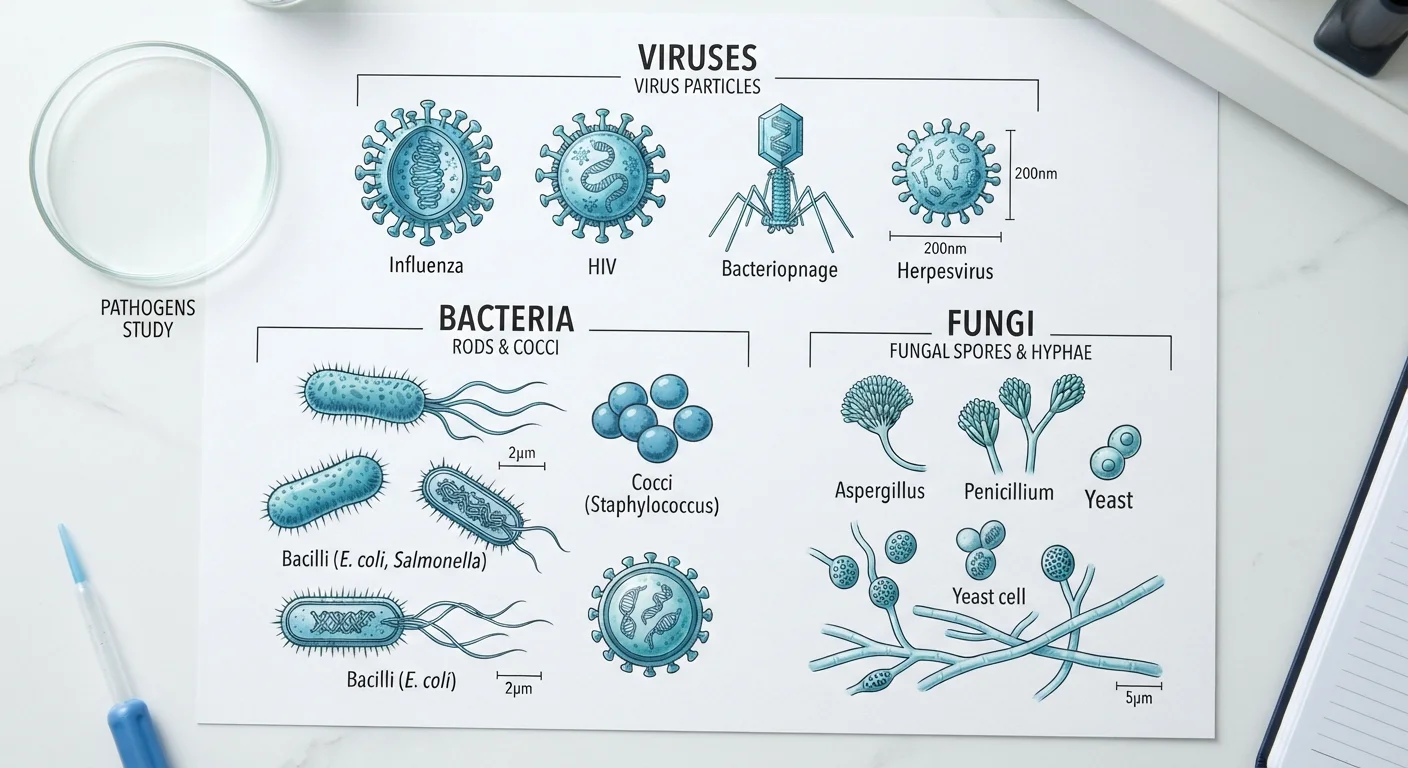
A pathogen is any microorganism capable of causing disease in a host. Pathogens fall into several broad categories: viruses, bacteria, fungi, parasites, and prions. Understanding which category a pathogen belongs to matters enormously - it directly shapes how an infection is diagnosed and treated. As explained in our guide to viruses vs. bacteria, antibiotics are effective only against bacterial infections and have no impact on viral ones.
Pathogen
A microorganism - such as a virus, bacterium, fungus, or parasite - capable of causing disease in a host. Different pathogens require different treatments.
Bacterium
A single-celled organism that can live independently and reproduce on its own. Many bacterial infections are treatable with antibiotics when appropriately prescribed.
Virus
A microscopic agent that can only replicate inside the living cells of a host organism. Antibiotics are ineffective against viral infections; antiviral medications exist for some.
Parasite
An organism that lives on or inside a host and derives nutrients at the host's expense. Parasitic infections vary widely in severity and are often treated with antiparasitic drugs.
Vector-borne disease
An infection transmitted to humans through the bite of an infected animal or insect, such as a tick or mosquito. Lyme disease and malaria are well-known examples.
Fungal infection
An illness caused by a fungus invading tissues of the body. Common examples include athlete's foot and ringworm; antifungal medications are the standard treatment.
For a fuller picture of how infections unfold inside the body, see our beginner's overview of infectious diseases.
Common Infections and Their Causative Pathogens
The table below lists widely recognized infections alongside the specific pathogen or pathogen type responsible. This is general reference information - it is not a diagnostic tool. Always consult a qualified healthcare professional for evaluation of any symptoms.
| Most common cold pathogen | Rhinovirus (CDC, General Respiratory Illness Information) |
| Leading cause of bacterial UTIs | Escherichia coli (E. coli) (National Institute of Diabetes and Digestive and Kidney Diseases) |
| Malaria parasite genus | Plasmodium (5 species infect humans) (World Health Organization, Malaria Fact Sheet) |
| Strep throat causative agent | Group A Streptococcus (GAS) (CDC, Group A Streptococcal Disease) |
| Pathogen types that cause human infection | Viruses, bacteria, fungi, parasites, prions (National Institutes of Health, MedlinePlus) |
| Infection | Pathogen | Type |
|---|---|---|
| Influenza (flu) | Influenza A or B virus | Virus |
| COVID-19 | SARS-CoV-2 | Virus |
| Common cold | Rhinoviruses (most commonly) | Virus |
| Chickenpox | Varicella-zoster virus (VZV) | Virus |
| Measles | Measles morbillivirus | Virus |
| Strep throat | Streptococcus pyogenes (Group A Strep) | Bacterium |
| Tuberculosis | Mycobacterium tuberculosis | Bacterium |
| Lyme disease | Borrelia burgdorferi | Bacterium |
| Urinary tract infection (UTI) | Escherichia coli (most commonly) | Bacterium |
| Pneumonia | Streptococcus pneumoniae, influenza virus, others | Bacterium/Virus |
| Athlete's foot | Trichophyton species | Fungus |
| Malaria | Plasmodium species | Parasite |
| Giardiasis | Giardia lamblia | Parasite |
| Ringworm | Dermatophyte fungi | Fungus |
Note that some infections - such as pneumonia - can be caused by more than one type of pathogen, which is why laboratory testing is often essential for accurate diagnosis. Overlapping symptoms frequently make infections difficult to distinguish on appearance alone; our article on misreading infection symptoms explores the patterns that most commonly mislead people.
How Pathogens Reach the Body
Different pathogens travel via different routes. Respiratory viruses like influenza spread primarily through droplets released when an infected person coughs or sneezes. Bacteria such as E. coli often enter through contaminated food or water. Vector-borne pathogens - like the Borrelia bacterium behind Lyme disease - are transmitted through the bite of an infected tick. Some infections originate in animals before crossing to humans; our article on zoonotic diseases covers this phenomenon in detail.
Transmission Routes Vary by Pathogen
Not all infections spread the same way. Respiratory viruses travel through the air or surface contact, while parasites like Plasmodium require a mosquito vector. Foodborne bacteria enter through ingestion. Understanding how a pathogen moves helps explain why prevention strategies differ - handwashing stops some infections but cannot prevent all of them. See our article on how infectious diseases spread for a comprehensive breakdown.
Understanding transmission routes is valuable context, but it's worth knowing the precise distinction between an infection being infectious and being contagious. Our companion piece on contagious vs. infectious clarifies the difference.
When to Seek Medical Attention
Many infections resolve without medical intervention. However, certain signs - high or prolonged fever, difficulty breathing, severe pain, rash, or symptoms that worsen rather than improve - warrant prompt evaluation by a healthcare professional. Some infections that appear mild can progress quickly, particularly in young children, older adults, pregnant individuals, or people with underlying health conditions.
For guidance on which infections typically clear on their own versus which require treatment, see why some infections resolve on their own. If you're experiencing symptoms and need guidance, consult your primary care provider or an urgent care clinician rather than relying on online references alone.
This article is for general informational and educational purposes only and does not constitute medical advice. Always seek the guidance of a qualified healthcare professional for questions about your health or any symptoms you may be experiencing.