

Key Takeaways
Option A
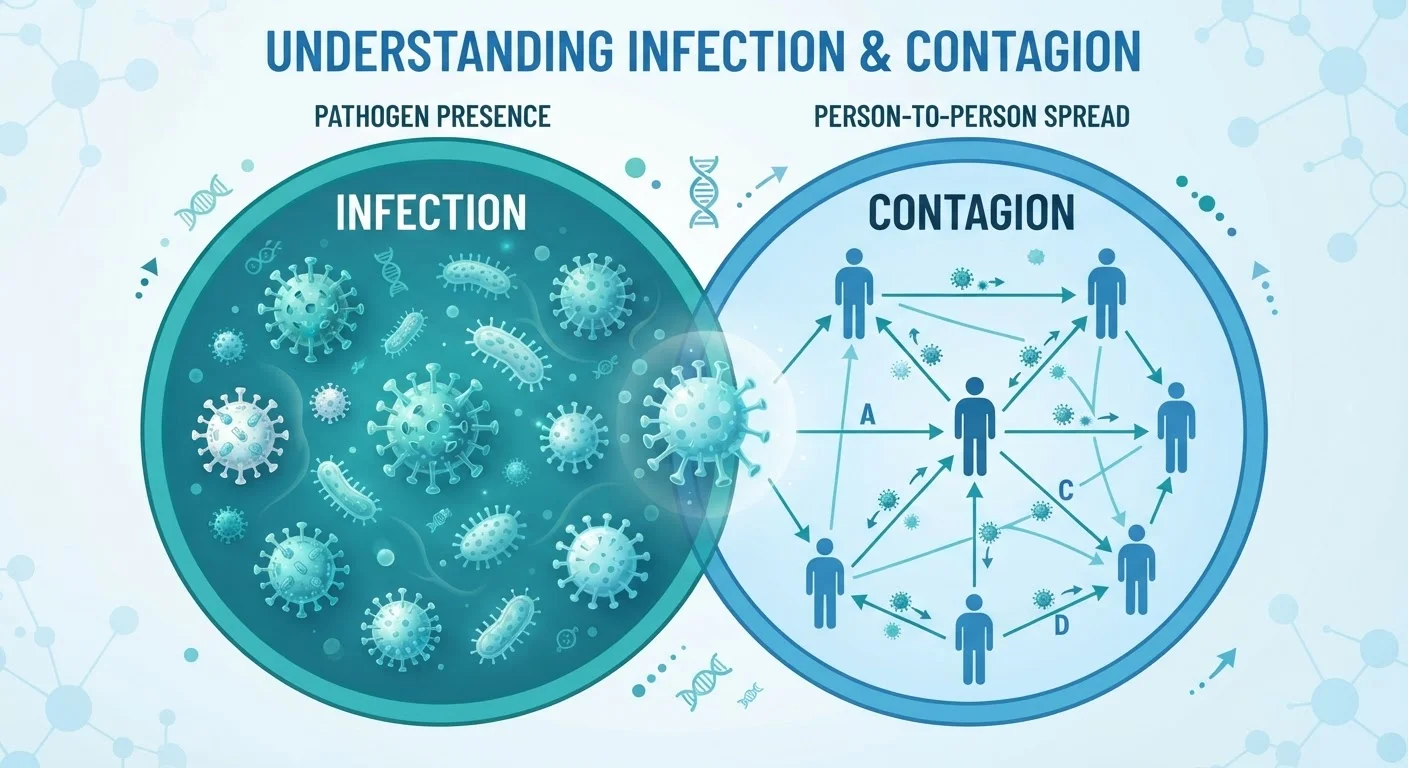
Infectious
The broader, foundational medical term.
Best for: Describing any disease caused by a pathogen - whether or not it can spread between people.
Option B
Contagious
The specific subset that spreads person to person.
Best for: Describing diseases that transmit directly from one person (or animal) to another with relative ease.
If you want to understand whether a disease requires isolation or quarantine
Contagious
The concept of contagiousness is what drives isolation recommendations - if a disease spreads person to person, limiting contact is the key prevention tool.
If you want to understand how a disease originates or what causes it
Infectious
Knowing a disease is infectious tells you a pathogen is involved, which shapes diagnosis, treatment selection, and hygiene practices regardless of transmissibility.
If you are trying to explain disease spread to someone else
Contagious
Contagious is the more intuitive, everyday term for person-to-person spread and tends to communicate transmission risk more clearly to a general audience.
Why This Distinction Matters in Everyday Health
In casual conversation, infectious and contagious are treated as synonyms. In medicine, they are not - and collapsing the two can lead to unnecessary fear, misapplied precautions, or confusion about how illnesses actually spread.
The difference is not just semantic. It shapes how public health agencies issue guidance, how clinicians advise patients, and how individuals should respond when they or someone around them is sick. For a foundational understanding of how pathogens cause disease in the first place, see our beginner's overview of infectious diseases.
| Criterion | Infectious | Contagious |
|---|---|---|
| Core definition | Caused by a pathogen | Spreads person to person |
| Scope | Broader category | Subset of infectious diseases |
| Requires a pathogen | Yes | Yes |
| Requires person-to-person spread | No | Yes |
| Example disease | Tetanus (not contagious) | Influenza (both) |
| Isolation typically advised | Not always | Usually yes |
| Drives outbreak tracking | Partially | Central metric |
What 'Infectious' Actually Means
A disease is classified as infectious when it is caused by a biological pathogen - a virus, bacterium, fungus, parasite, or prion - that can invade a host and cause harm. The defining feature is the presence of a causative organism, not the ability to spread.
Tetanus is a clear example. It is caused by the bacterium Clostridium tetani, which typically enters the body through a wound contaminated with soil. Tetanus is definitively infectious, but a person with tetanus poses no transmission risk to those around them - it is not contagious. The same logic applies to many fungal infections and certain parasitic diseases acquired from environmental exposure rather than human contact.
Understanding which organism is responsible also directly affects treatment. Antibiotics target bacteria, not viruses - so identifying the pathogen is step one in any clinical response.
~60%
Infectious diseases with zoonotic origins
The CDC estimates that approximately 60% of known infectious diseases in humans originated in animals, according to longstanding epidemiological research.
18
Measles basic reproduction number (R₀)
Measles has an estimated R₀ of around 12-18, making it one of the most contagious diseases ever documented, according to epidemiological literature.
What 'Contagious' Adds to the Picture
Contagious describes a subset of infectious diseases - specifically those capable of spreading from one person (or animal) to another. The mechanism of transmission can vary widely: respiratory droplets, direct skin contact, bodily fluids, or contaminated surfaces. What all contagious diseases share is the property of person-to-person transmissibility.
Influenza, measles, and COVID-19 are all both infectious and contagious. They are caused by pathogens and they spread between individuals, which is why isolation, masking, and vaccination are relevant containment strategies. The routes that make a disease contagious differ significantly - our guide to airborne, droplet, and contact transmission explains each pathway in detail.
It is also worth noting that contagiousness exists on a spectrum. Measles is among the most contagious diseases known; HIV, while infectious and transmissible, requires specific conditions for transmission and is far less easily spread in daily life.
Zoonotic Diseases: Infectious but Not Always Contagious
Many diseases that originate in animals - called zoonotic diseases - are infectious to humans but not contagious between people. Rabies, for example, is acquired through animal bites and does not spread from human to human under ordinary circumstances. Understanding this distinction is important when evaluating disease risk after animal exposure. See our article on zoonotic diseases and how they spread for more detail.
Putting the Terms to Work
Knowing whether a disease is simply infectious or also contagious changes practical decision-making. If someone is diagnosed with a wound infection caused by a localized bacterium, there is generally no need for household members to isolate or wear masks. If that same person has influenza, those precautions become genuinely relevant.
Public health language often relies on this distinction too. Outbreak investigations track the reproductive number (how many new cases one case generates) - a measure that only applies to contagious diseases. For a broader look at how specific pathogens link to specific illnesses, common infections and the pathogens behind them is a useful reference.
If you are unsure whether a condition you or someone close to you has poses a transmission risk, a healthcare provider is the appropriate source of guidance. General information is a starting point - not a substitute for professional evaluation.
This article is for general informational and educational purposes only and does not constitute medical advice. Always consult a qualified healthcare professional regarding any health concerns or before making decisions related to your health.