

Key Takeaways
Immune Response to Infection
The immune response is your body's organized defense system that activates when a pathogen - such as a virus, bacterium, or fungus - enters the body. It involves multiple cell types, proteins, and organs working in sequence to detect, neutralize, and remember the threat. The response unfolds in distinct stages, from immediate physical barriers to long-term immunological memory.
Immunologists broadly divide the response into innate immunity (fast, non-specific) and adaptive immunity (slower, highly targeted), each engaging different cellular and molecular mechanisms.
Stage One: The Body's First Line of Defense
Before any immune cell fires, your body's physical and chemical barriers work to stop pathogens at the point of entry. Skin, mucous membranes, nasal hair, and the acidic environment of the stomach are all part of this passive defense. If you're new to how infections begin, our beginner's overview of infectious diseases provides helpful foundational context.
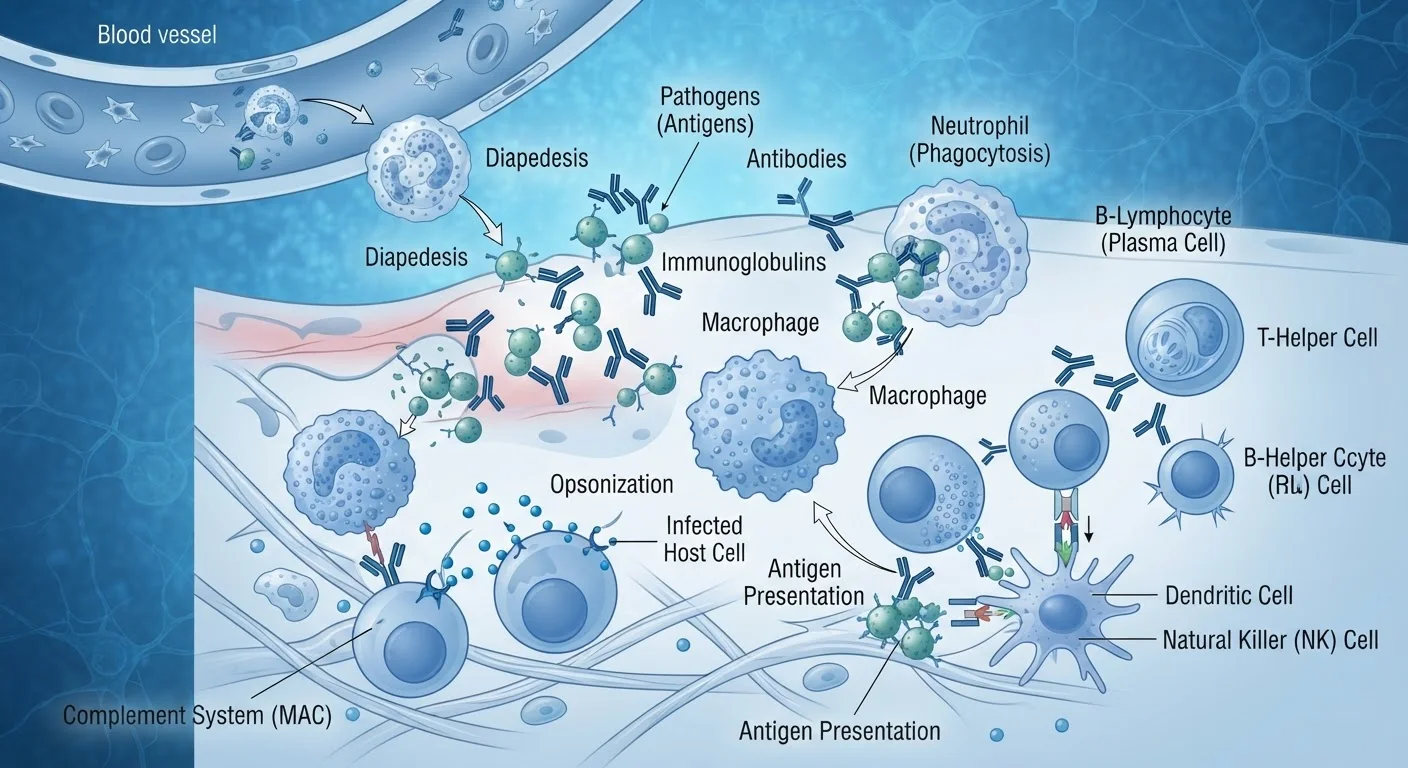
When a pathogen does breach these barriers - through a cut in the skin, inhalation into the lungs, or ingestion - the innate immune system activates almost immediately. Specialized cells called pattern recognition receptors detect molecular signatures common to many pathogens. Within minutes, mast cells and macrophages at the infection site begin releasing chemical signals called cytokines, triggering localized inflammation: redness, warmth, and swelling that indicate immune activity has begun.
Innate Immunity Is Not Specific
Unlike the adaptive immune system, the innate response does not distinguish between different types of viruses or bacteria. It responds to broad molecular patterns shared by many pathogens. This means it activates quickly but cannot provide the targeted, lasting protection that the adaptive system builds over time.
Stage Two: The Innate Immune Response in Action
Once the alarm signals spread, the innate immune response mobilizes rapidly. Neutrophils - the most abundant white blood cells - flood the site of infection and engulf or destroy pathogens through a process called phagocytosis. Natural killer (NK) cells target and destroy body cells that have already been infected by viruses, preventing further replication.
Systemically, cytokines reach the hypothalamus in the brain and trigger a rise in body temperature. This fever is not a malfunction - it creates an environment less hospitable to many pathogens and accelerates immune cell activity. Fatigue is similarly purposeful: conserving energy redirects the body's resources toward the immune effort.
It's worth noting that the symptoms you feel during this stage are largely a product of your immune response, not the pathogen itself. Understanding the incubation period before symptoms appear helps explain why there's often a delay between exposure and feeling ill.
~100 billion
Neutrophils produced by bone marrow daily
According to published hematology research, the bone marrow generates approximately 100 billion neutrophils per day to sustain the innate immune response.
7-14 days
Typical timeframe for adaptive immune response
Peer-reviewed immunology literature generally identifies one to two weeks as the window for the adaptive immune system to produce significant pathogen-specific antibodies.
37°C (98.6°F)
Normal human core body temperature
A fever represents the immune system deliberately raising core temperature above this baseline to inhibit pathogen replication and enhance immune cell activity.
Stage Three: The Adaptive Immune System Takes Over
While the innate response buys time, the adaptive immune system builds a targeted counterattack. Dendritic cells act as messengers: they capture fragments of the pathogen, travel to nearby lymph nodes, and present these fragments - called antigens - to T lymphocytes (T cells).
Two key T cell types emerge. Cytotoxic T cells seek out and destroy infected cells. Helper T cells coordinate the broader response, including signaling B lymphocytes (B cells) to produce antibodies - proteins precisely shaped to bind to the specific pathogen and neutralize it. This entire process typically takes several days to a week, which is why symptoms often worsen before improving.
“The adaptive immune response is one of evolution's most sophisticated achievements - a system capable of learning, remembering, and improving its response to virtually any biological threat it has encountered before.”
— National Institute of Allergy and Infectious Diseases, U.S. federal agency for infectious disease and immunology research
Stage Four: Resolution and Immunological Memory
As the pathogen load decreases, regulatory signals wind down the immune response to prevent ongoing inflammation from damaging healthy tissue. Most of the T and B cells that were mobilized undergo programmed cell death - a controlled process called apoptosis. However, a critical subset survives as memory cells.
These long-lived memory T and B cells carry the blueprint of the defeated pathogen. On future exposure to the same threat, they enable a dramatically faster and stronger response - often neutralizing the pathogen before significant symptoms develop. This is the biological basis of immunity following infection, and it underpins how vaccines work.
Whether your body clears an infection entirely on its own depends on factors including pathogen type, initial infectious dose, and individual immune health. Our article on why some infections resolve without treatment explores this further. For a closer look at how these stages apply specifically to bacteria, see our guide on what happens inside the body during a bacterial infection.
This article is for informational and educational purposes only and does not constitute medical advice. Always consult a qualified healthcare professional for concerns about your health or any symptoms you are experiencing.