

Key Takeaways
Balance and Coordination Training
Balance and coordination training refers to exercises specifically designed to improve the body's ability to maintain stable posture and control purposeful movement. Unlike strength or cardio work, these exercises target the neuromuscular system - the communication network between the brain, nerves, and muscles. For older adults, this type of training directly addresses one of the most common and consequential changes that comes with aging: the gradual decline in postural stability and movement precision.
Proprioception - the body's internal sense of its own position in space - degrades with age and is a primary driver of balance decline. Targeted training can partially restore proprioceptive sensitivity by stimulating sensory receptors in joints, muscles, and the inner ear.
Why Balance Deserves a Spot on the Schedule
Most fitness routines for older adults focus on cardiovascular endurance and muscle strength - both genuinely important. But there is a third pillar that is frequently overlooked: neuromuscular training, which encompasses balance and coordination. Skipping it leaves a meaningful gap in any healthy aging strategy.
Falls are among the most serious health risks for adults over 65. According to the Centers for Disease Control and Prevention (CDC), falls are a leading cause of injury-related hospitalization in older adults. What makes this particularly significant is that postural instability - the underlying driver - is not an inevitable consequence of aging. It is a trainable quality.
As we age, the systems that maintain balance - vision, the vestibular system in the inner ear, and proprioception in the joints and muscles - all experience some decline. But like muscle mass, these systems respond to deliberate practice. Regular balance training challenges these pathways and helps preserve or rebuild the neural connections that keep us upright and agile.
1 in 4
Older adults who fall each year
The CDC reports that approximately one in four Americans aged 65 and older experiences a fall annually.
40%
Reduction in fall risk from balance training
A Cochrane Review of exercise programs found that balance and functional exercise can reduce fall rates in older adults by approximately 23-40%.
8 weeks
Time to see balance improvements
Research on structured balance training programs suggests measurable improvements in postural stability can emerge in as little as eight weeks of consistent practice.
To understand how movement priorities shift across the decades, see our guide to active aging and changing movement patterns.
What Coordination Training Actually Does
Coordination refers to the brain and body working together to produce smooth, accurate, and well-timed movement. It is what allows you to step over an uneven curb without stumbling, reach for an object without knocking others over, or change direction quickly when the sidewalk unexpectedly ends.
Coordination is not just a physical attribute - it is a cognitive one. Exercises that require sequencing, rhythm, or dual-tasking (such as walking while counting or stepping in patterns) activate working memory and executive function alongside the motor system. This dual engagement is one reason coordination training has attracted attention in brain health research.
“Balance is not a fixed trait - it is a skill that responds to practice. The nervous system retains a remarkable capacity for adaptation well into later life, and targeted movement challenges are one of the most reliable ways to tap into that capacity.”
— Editorial synthesis from published exercise physiology literature, Healthy Aging Editorial Team
Importantly, coordination work differs from cardio and strength training in its demands on the nervous system rather than the metabolic or musculoskeletal system alone. This is why it benefits from its own dedicated practice time, rather than being assumed as a byproduct of other exercise types.
For a broader picture of how exercise physiology shifts with age, our article on strength training after 60 offers complementary context.
Practical Ways to Build These Skills
The good news: balance and coordination training requires minimal equipment and can fit into almost any routine. Below are evidence-supported approaches.
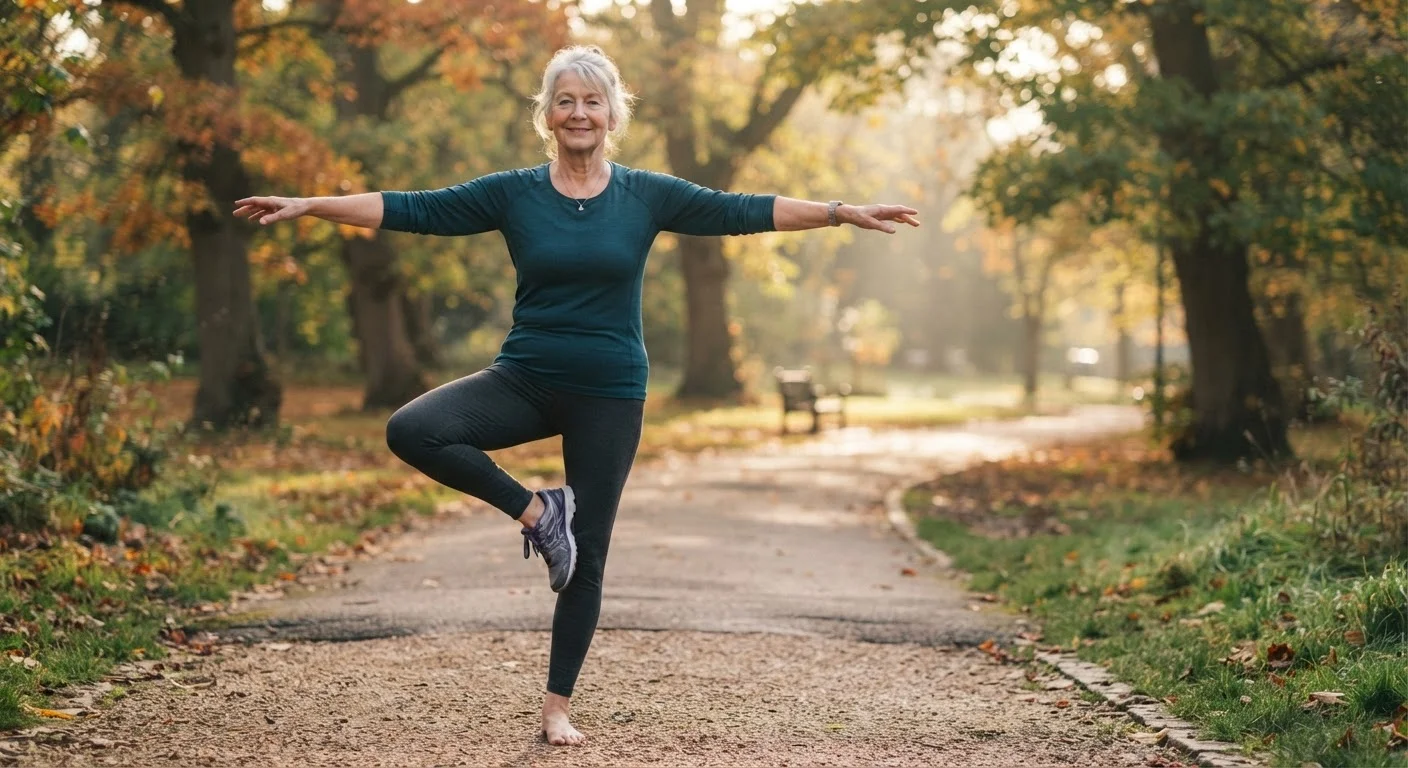
- Single-leg standing: Stand on one foot near a wall or sturdy chair for support. Hold for 10-30 seconds and switch sides. Progress by closing your eyes briefly once you're stable.
- Heel-to-toe walking: Walk in a straight line placing the heel of one foot directly in front of the toes of the other. This challenges the vestibular and proprioceptive systems simultaneously.
- Tai chi or yoga: Both are backed by strong evidence for improving postural stability and reducing fall risk in older adults. Even a beginner class twice a week produces measurable benefits.
- Tandem stance: Stand with one foot directly in front of the other (like standing on a balance beam) and hold for up to 30 seconds. This is a standard clinical balance assessment - and a training exercise in its own right.
- Step-pattern drills: Use floor markers or lines to practice stepping in specific sequences. Adding a count or rhythm introduces a coordination challenge that also engages cognitive function.
Start With a Stable Surface, Then Progress
If you are new to balance training, always begin near a wall, countertop, or sturdy chair that you can grab if needed. As your stability improves, gradually reduce your reliance on the support. Progressing too quickly increases fall risk, so patience is part of the practice.
Consistency is the primary driver of progress in balance training. For more on why regularity outperforms intensity in healthy aging, see why consistency matters more than intensity in aging well.
This article is for general informational and educational purposes only and does not constitute medical advice. Always consult a qualified healthcare provider before beginning a new exercise program, particularly if you have existing health conditions, a history of falls, or concerns about balance or mobility.